
Confusion to Clarity: 10 Steps to the Right CBCT
· David Hanning
There are at least 50 different CBCT units in the US market. Selecting the best CBCT for your practice can be a confusing task. Every salesperson you speak with will try and convince you that they have the best CBCT solution for you. How do you decide? Selecting the best Cone Beam Computed Tomography (CBCT) system for your dental practice is a crucial decision that can impact the quality of your service, your workflow, and your overall patient satisfaction. With a vast array of CBCT systems in the market, it can be challenging to find the one that suits your unique needs. Here’s a step-by-step guide to help you make an informed choice:
Step 1: Understand Your Clinical Needs Start by assessing the needs of your practice for CBCT based on the procedures that you will be performing with the CBCT scans that you acquire. Consider the type of dental procedures you perform regularly. Will you be using CBCT for endodontic procedures, implant planning, oral surgery, orthodontics, or a combination? Do you need a device that can scan a single tooth with detail, a specific quadrant, or the entire maxillofacial area? Understand the field of view (FOV) that suits your clinical requirements and start by narrowing the field to just that machine.
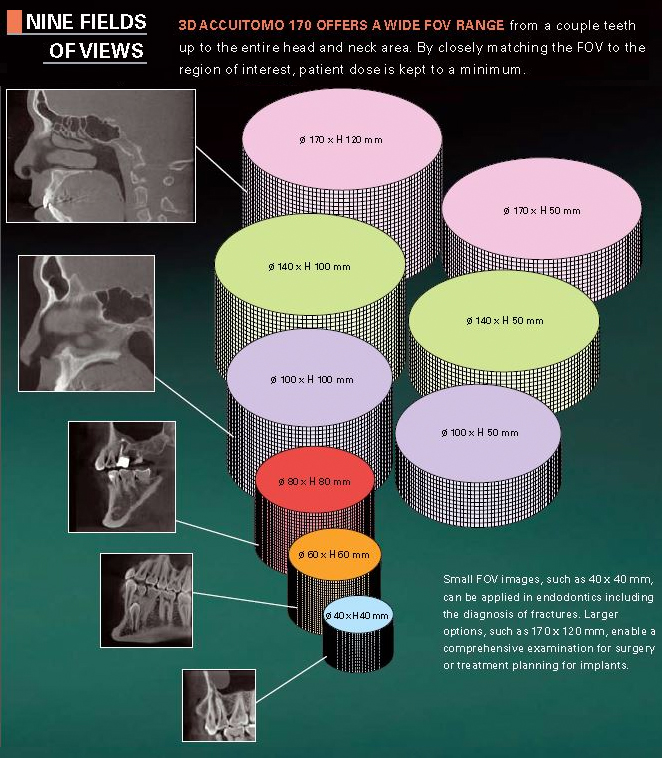
The illustration below illustrates the nine different FOVs offered by the J.Morita 3D Accuitomo 170. This illustration is used to show the varying FOVs that CBCT can offer.
Step 2: Set Your Budget Dental CBCT systems can range significantly in cost. At the low end of the new CBCT price spectrum, small and medium FOVs start around $50K. Keep in mind that these “economy” units are less expensive for a reason. Typically, the build quality and image quality are going to be inferior to the most expensive units in the small to medium price range which can be in the $70-$80K range. Bear in mind that the overall cost includes the price of the system, installation, training, maintenance, and possible software updates. Some warranties include parts and labor while other warranties cover only parts. It is important to read your warranty and understand the limitations and exclusions. Also, realize that most warranties do not cover the PC and the IT maintenance related to the PC.
Remember, the cheapest is not necessarily the least costly as ROI determines true cost over a period of time. If you do not see the quality needed for diagnosis and the CBCT does not last until fully amortized, then the cheapest CBCT can actually be the most costly. This defines the difference between price and cost which is driven by true value.
Step 3: Analyze Image Quality. Image quality can vary widely amongst different FOVs and different CBCTs. Normally, smaller voxels produce greater detail. A voxel, or volume pixel, is the 3D equivalent of a pixel. It represents a value on a regular grid in three-dimensional space. These values can represent various types of data, such as color and transparency, in computer graphics and similar fields.
The size of the voxel influences the resolution of the CBCT scan: smaller voxels result in higher resolution but require more computing power and time to process. Conversely, larger voxels result in lower resolution but are quicker and less computationally intensive to process.
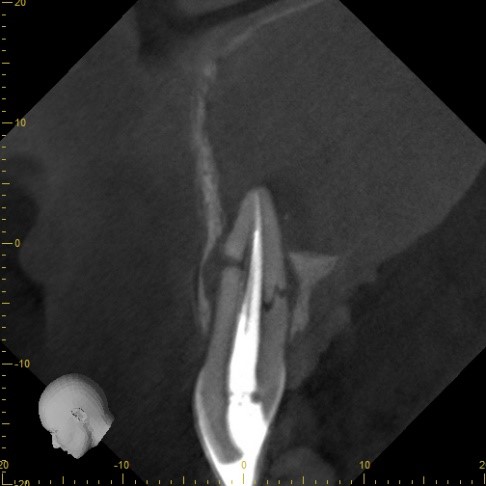
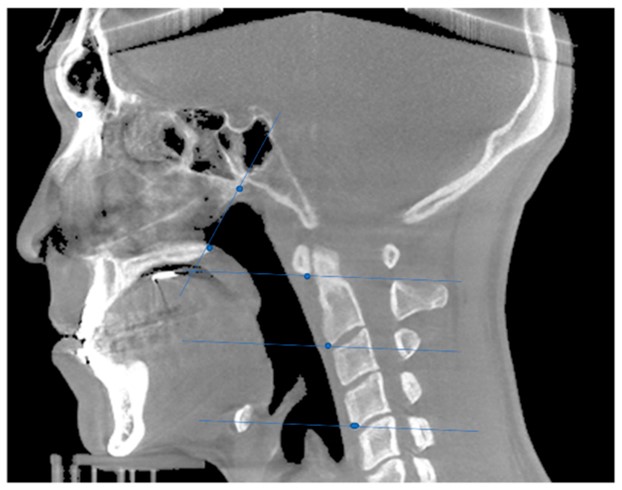
High-quality CBCT systems should produce images with high resolution, low noise, and precise details. However, small FOVs for endo as an example, will be taken with a lower voxel size (typically .075-.125mm) and show greater detail than a larger FOV scan taken for the airway. Larger FOV scans usually are taken with a voxel size of .20-.40mm as the detail required to determine airway obstruction is less than what is required to see a root fracture. Below are examples of a small FOV high-resolution endo scan and a large FOV low-resolution airway scan. Both are perfectly suited for their respective applications.
Hi-Resolution .08mm endo scan from the JMorita X800 F40
Low-Resolution .40mm Airway Scan
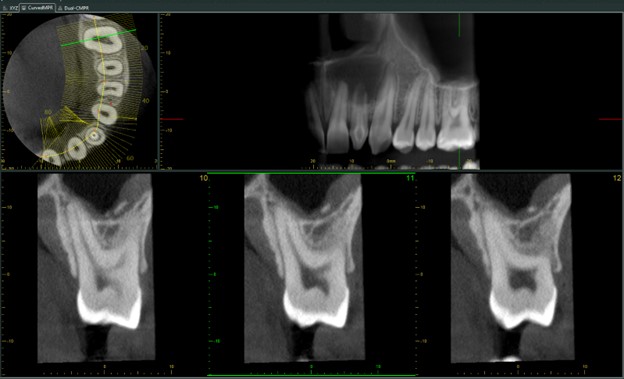
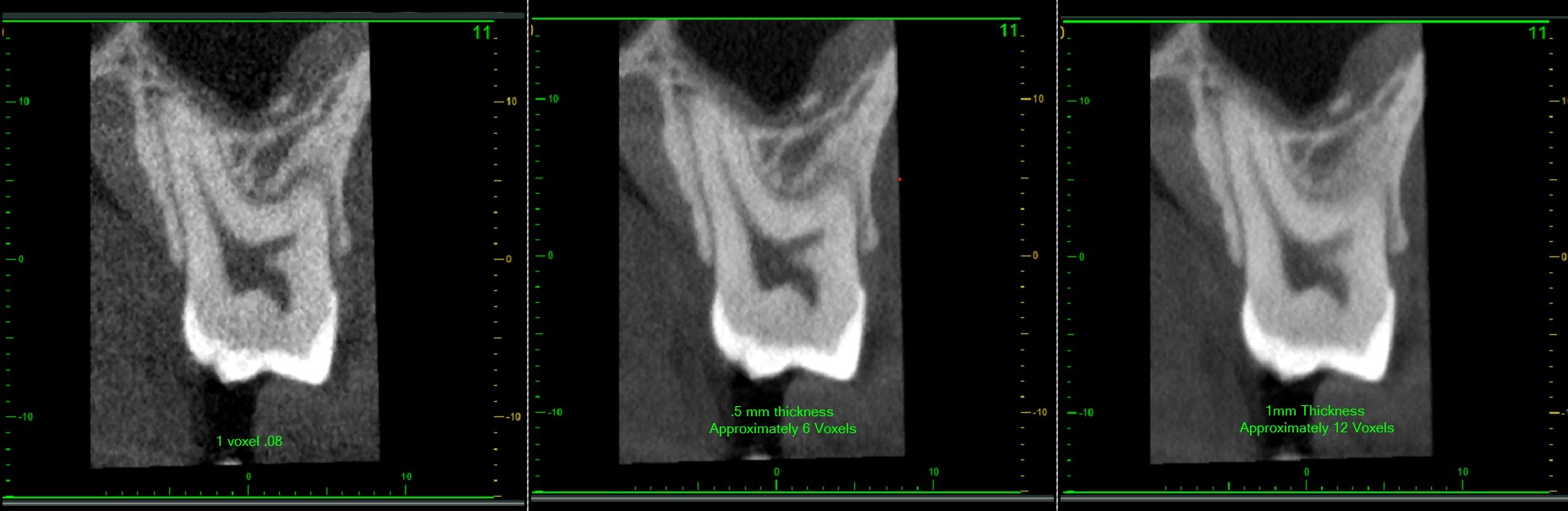
One way to evaluate image quality is to draw an MPR (Multi Planar Reconstruction) on the axial image and evaluate the slices with varying slice thicknesses and the smallest interval, typically .5 mm. The thickness refers to each slice and the interval is the spacing from slice to slice. Looking at this detail is where you will see quality separation among the various CBCT machines. Evaluate the detail in the minimum slice thickness as that represents a single voxel. The image presented will have more graininess than an image that has a greater thickness as it is a thinner slice with less information. An example of different slice thicknesses from slices taken from an MPR at the same location. For typical use, a 1mm thickness is very readable while appearing smooth. For evaluating fractures, being able to look at an image in the thinnest slice can be very helpful. Comparing the smallest voxel quality of scans is a good way to see what details the prospective CBCT is able to capture.
Example of an MPR curve. Slices are represented in the three panels.~ 1mm slice thickness.
Single Voxel .08mm thickness ~6 Voxels .5mm thickness ~12 Voxels 1mm thickness
Another way to evaluate true image quality is to request the manufacturer’s MTF numbers for each FOV and resolution from a particular machine. The modulation transfer function (MTF) is well known as a crucial parameter in the quality assurance of computed tomography (CT) scanners, which provides detailed information on both the contrast and resolution of CT images. Read the following study to learn more about MTF in the evaluation of CBCT image quality.
Study on MTF with the J Morita Accuitomo 170.
Read the MTF study on the J. Morita Accuitomo 170 (NCBI)
Step 4: Evaluate Usability Ease of usability involves the workflow from integration to your PMS, patient positioning, and image acquisition, to image reconstruction and visualization. Integration from PMS should minimally allow for creating a patient in the PMS (Dentrix, Eaglesoft, Open Dental, etc.) with one click of the mouse. When positioning a patient, it is important that the CBCT you choose allows for imaging short neck, big shoulder individuals as the C-Arm will often collide with the tops of the shoulders. Some CBCT machines allow for increasing the vertical distance between the rotating C-arm and the tops of the shoulders, while others do not. Non-adjustable machines are more prone to shoulder collisions upon rotation. There are patient positioning tricks to pull the tops of the shoulders down, but, it can be very useful if the CBCT unit allows for vertical adjustment of the sensor and tube head that hang down as the C-arm rotates.
Evaluate the ease of acquisition and the interface of the CBCT system. Acquisition of the CBCT image is critical in resultant quality. This means proper positioning and stability of the patient will determine the quality of the result.
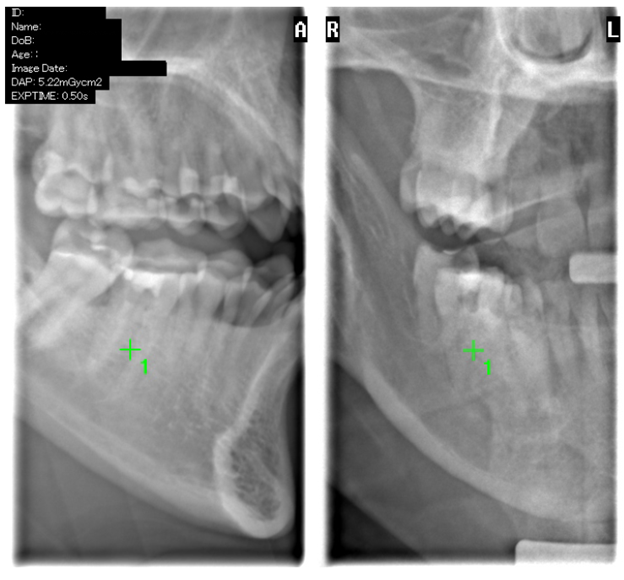
The center of focus of a CBCT scan always reflects the highest accuracy in the overall scan. For small FOVs like 40mmX40mm scans used for endo, getting the center of focus on the mid roots of the tooth being scanned is critical to optimizing quality. Using a CBCT with a two-directional scout function allows for taking a low-dose 2D coronal and sagittal image and then picking the exact location in each image that will be the center of the 3D scan. This means you will have the greatest level of detail where the scout image is taken. In the image below, that location is marked with a green crosshair and a number one.
Example of two-directional scouting offering precise locating for a 40X40 FOV.
The software provided by the CBCT manufacturer should allow for fast reconstruction times after the images are taken and easy tools to allow for the visualization of areas of concern quickly. Most programs allow for exporting volumes with a “lite” version of the software that will allow for evaluating the image quality and software functionality. It is important to get different FOV volumes from each manufacturer to evaluate carefully and objectively without a salesperson present.
A practical way to run that comparison: request DICOM volumes directly from each manufacturer you’re considering — ask for volumes that include restorations, since every CBCT unit produces some artifacting (beam hardening, scatter) around metal, and seeing how each system handles it tells you more than a clean marketing scan ever will. Load the volumes into a free viewer like Blue Sky Plan and step through the axial, sagittal, and coronal views side by side. Watch specifically for dark shadowing under restorations — beam hardening can be mistaken for decay if you don’t know to expect it.
Ease of usability involves the workflow from integration to your PMS, patient positioning, and image acquisition, to image reconstruction and visualization. Objectively evaluate the software. Does it offer the features you need like implant planning, airway analysis, TMJ analysis, cephalometric analysis, etc.? Remember, all CBCTs generate DICOM information. So, if you really like the quality of a particular unit and don’t like the planning software, you can choose to use different software for airway and implant planning. BlueSky Plan is a great option as the software is a pay as you use it fee where you only pay when you export STL scans for a purpose such as printing a surgical guide.
Example BlueSky Plan and creating a surgical guide
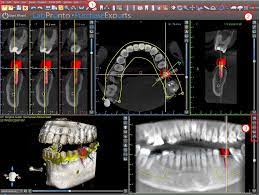
Video showing the “wizard” workflow in BlueSky Plan
Step 5: Review Training and Support The best CBCT system should come with comprehensive training for you and your staff. The manufacturer should offer prompt and reliable technical support to minimize downtime in case of system glitches or failures. Most manufacturers don’t sell directly to the end user but rely on distributors to sell and provide the first line of tech support to the purchasing dental practice. Make sure that the company selling you your CBCT is knowledgeable and can add value to your purchase by providing service when needed and training as well. It is good to ask to speak to other dentists who have used the prospective company to see how the service is after the sale. Also, see if the company and the manufacturer have ongoing educational materials like Dental TI’s CBCT portal produced by Oral Radiologist Bruno Acevedo accessible through Dental TI’s CBCT education portal.
This educational portal focuses on the J. Morita line of CBCTs. The portal offers eleven-plus hours on the four pillars of CBCT - Acquisition, Data Correction, Data Navigation, and 3D Interpretation. I typically say that most users range from 1-10 on expertise when it comes to CBCT. Most dentists who have not purchased CBCT range from a 1-3 on their knowledge level of CBCT and how to manage the four pillars that Dr. Acevedo teaches. Whereas most dentists will never have a knowledge level of 10, like Dr. Acevedo, watching and studying the eleven hours of education in the Dental TI portal is enough to get into the 5-7 range of CBCT knowledge. Taking in-person courses from CBCT experts can further elevate knowledge to the 8-9 range. It is important to note that CBCT education should be an ongoing journey, not a destination.
Step 6: Assess Space Requirements The size of the CBCT system is another factor to consider. Make sure you have enough space in your practice for the machine, operator, and patient to take scans comfortably. It is important that the space allows for wheelchair access to be ADA-compliant. Also, check your state’s rules on CBCT installation. Many states require that a physicist complete a shielding evaluation indicating that the machine is in a location where staff members will not be routinely exposed without adequate distance from the machine. If, for example, a CBCT is mounted on a wall that is opposed by a hygiene room where the hygienist is a few feet on the opposite side of the mounted CBCT, a thin sheet of lead or an extra thickness of drywall may be specified by the physicist for occupational safety.
Step 7: Ask for a Demonstration Once you have a shortlist, ask the vendors for a demonstration of their CBCT systems. This gives you a firsthand experience of how the system operates, its user-friendliness, and the quality of the images. Unless you go to an office that has the CBCT installed, you will likely have to rely on videos and scan volumes to make your decision. I recommend that for each machine you are considering, speak to at least two to three end users and ask about the entire experience from installation to training, and daily patient use.
Step 8: Research on Vendor Reputation Consider the reputation of the vendor. Are they known for their excellent customer service? How quickly do they respond to service calls? Look for reviews and ask for references from other dentists who have used their products and needed support. Was the support readily available and was the technician able to resolve the issue quickly?
Step 9: Think About Future Needs Lastly, keep your future needs in mind. As your practice grows and evolves, your needs may change. Therefore, consider a system that is upgradeable or one that will still meet your needs a few years down the line. For example, if you are an endodontist, will you only be taking small FOV scans (e.g. 40X40)? Or, may you take larger FOV scans for a fee for referring dentists? Most small FOVs are not upgradeable to a mid-FOV so making the correct decision means you will not have to sell your unit before fully amortized as your FOV needs increased. When there is a question of “maybe” using a larger FOV in the future, make the decision today to upsize FOV and protect the useful life of your investment.
Step 10: Take the plunge. Figure out the best way to purchase your CBCT (write a check or finance) and make it happen. Once you determine that CBCT will create a positive ROI for your practice, you are losing $ every day that you go without the technology.
Remember, the goal is not to find the most inexpensive CBCT system but rather the one that fits your specific needs while providing the best value for your investment. The right CBCT system will enhance your practice, improve your diagnosis, and ultimately lead to better patient outcomes. Dental TI has been an industry leader in providing high-quality installation, training, and after-sales support for over a decade. If you are looking at investing in Dental CBCT, click the link below to arrange a consultation with an expert. We can inform you of your best options so you can make an intelligent investment in a CBCT that is right for your specific needs. Now is a great time to call as Dental TI is introducing our “Summer of Savings” program that can save you thousands on your investment.