
CBCT Machine ROI for Your Dental Practice
· David Hanning
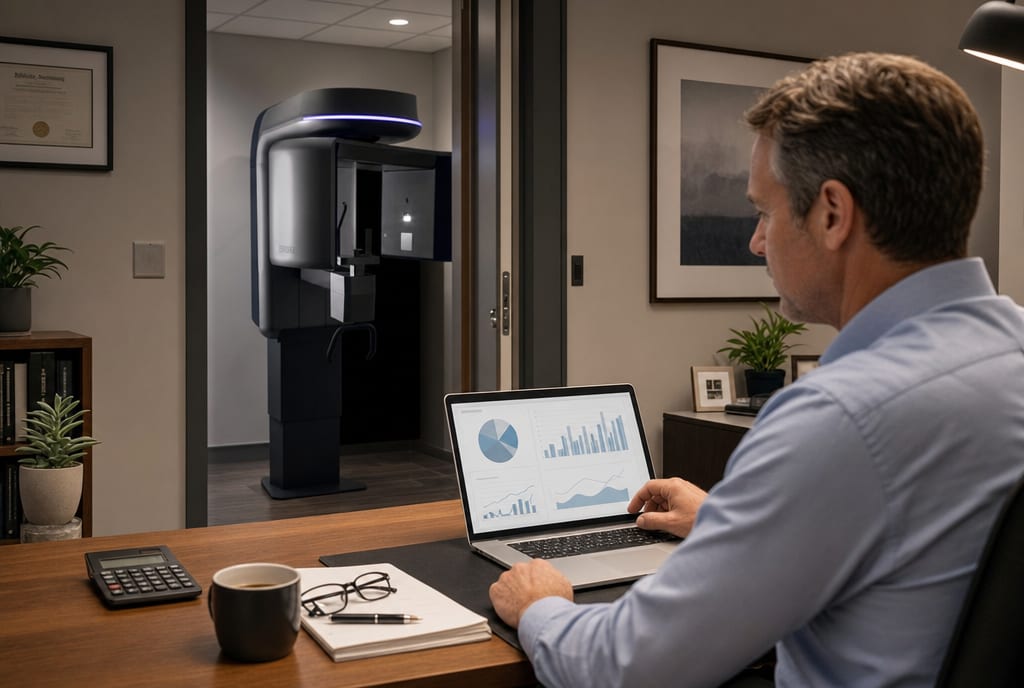
A CBCT purchase usually gets framed as a technology decision. In reality, it is a business decision that affects diagnosis, case acceptance, scheduling, referrals, and long-term production. That is why cbct machine roi for dental practice should be evaluated as more than a monthly payment or a price quote. The real question is whether the system will create measurable clinical and financial value without adding friction to daily operations.
For many practices, the answer depends less on whether CBCT is useful and more on whether the right system, training, and implementation plan are in place. A high-performing scanner that sits underused will not produce a strong return. A well-matched system that becomes part of diagnosis and treatment planning often will.
What drives CBCT machine ROI for dental practice
Return on investment comes from two sides at once: increased opportunity and reduced inefficiency. Most buyers focus first on revenue, which makes sense. In-house CBCT can support implant planning, endodontic diagnosis, oral surgery workflows, airway evaluation, and more advanced case presentation. When a practice can diagnose and plan with greater confidence on-site, it often keeps more procedures in house and reduces dependence on outside imaging centers.
That said, revenue is only part of the equation. ROI also improves when a practice shortens treatment planning time, reduces retakes, limits patient back-and-forth, and avoids delays tied to referrals for imaging. A CBCT unit can also improve the patient experience in ways that matter financially. Patients tend to move forward faster when they can see the problem clearly and understand the treatment recommendation in the same visit.
The strongest ROI cases usually come from offices that already have procedure demand but are constrained by imaging limitations. General practices placing implants, endodontic offices managing complex anatomy, oral surgery practices, and multi-provider offices often see returns sooner because the scanner is tied directly to existing production opportunities.
The numbers practices should actually model
A useful ROI model starts with current clinical volume, not best-case assumptions. If a practice is considering CBCT primarily for implants, the first question is how many implant cases are being referred out, delayed, or never presented because imaging is a bottleneck. If the primary use case is endodontics, the model should reflect how often three-dimensional imaging changes diagnosis, supports case acceptance, or helps avoid uncertainty that slows treatment.
Start with imaging volume and procedure mix. Estimate how many scans will be taken monthly, which procedures the scans support, and whether those procedures are already being performed or represent a growth opportunity. Then look at reimbursement and production impact. Some practices generate ROI through direct scan fees, while others see greater value through increased treatment acceptance and higher-value procedures kept in house. Both count, but they should be modeled separately.
Costs need the same level of honesty. Include the purchase price or lease payment, software, installation, training, service coverage, and any room preparation needed. Also account for the hidden cost of poor implementation. If the team is not trained well, if scan protocols are inconsistent, or if downtime drags on because support is weak, returns shrink quickly.
A simple payback calculation can be useful, but it should not be the only lens. Two systems with similar monthly costs can perform very differently if one produces faster workflows, better image quality, and fewer service interruptions.
A quick illustration of the math: a $75,000 system amortized over five years works out to roughly $1,250 a month. If the practice bills $250 per scan and takes just three scans a week — twelve a month — that’s $3,000 in monthly scan revenue against the $1,250 monthly cost, a $1,750 net benefit before counting any of the downstream treatment revenue those scans support. That’s a conservative, scan-fee-only view; it doesn’t touch the implant cases or endodontic treatment the imaging itself helped close.
Direct revenue versus downstream revenue
Direct revenue is the easiest piece to measure. This includes scan fees and any billable imaging tied to patient visits. Downstream revenue is where many practices underestimate value. Better imaging often leads to more confident diagnosis, stronger treatment recommendations, and more comprehensive care accepted inside the practice.
For example, a single implant case may justify more than the scan itself. The scan supports planning, guides communication, and can increase the likelihood that the case stays with your office instead of being fragmented across providers. The same is true in endodontics, oral surgery, and complex restorative planning. CBCT often pays back through treatment decisions, not just imaging charges.
Why utilization matters more than sticker price
A lower-cost unit is not automatically the better investment. If image quality is inconsistent, field of view is poorly matched to your procedures, or the software creates unnecessary steps, the scanner may be used less often than intended. That is a utilization problem, and utilization is one of the biggest predictors of return.
Practices should ask a practical question: will this scanner be used confidently by the clinical team every week, or will it be reserved for occasional cases because it feels cumbersome? The difference has a direct impact on ROI.
This is where consultative planning matters. The right fit depends on provider mix, procedure goals, patient flow, available space, and staff comfort with imaging protocols. A system that is ideal for a high-volume specialty office may be oversized for a general practice just beginning to expand implant services. On the other hand, buying too small can limit growth and force another upgrade sooner than expected.
The operational side of ROI
CBCT is often justified on diagnostic value, but operational gains deserve equal attention. When imaging happens in-house, scheduling becomes more predictable. Patients do not need to leave, wait for outside records, or return later for treatment planning that could have been completed earlier. That alone can improve case momentum.
In busy practices, time savings compound. Front office teams spend less effort coordinating outside imaging. Clinical teams work with immediate access to scans. Providers make decisions faster. Referring doctors, when relevant, receive information more efficiently. None of those gains may appear as a line item on a quote, but they affect profitability.
Downtime is part of the operational equation too. An imaging system that is unreliable or difficult to service can disrupt schedules and reduce provider confidence. That is why support should be evaluated as part of ROI, not as an afterthought. Installation quality, onboarding, remote support, troubleshooting response, and ongoing training all shape whether the machine becomes a productive asset or a recurring frustration.
Common mistakes that weaken ROI
One common mistake is buying based on features that sound impressive but do not match the practice’s actual clinical use. A practice may pay for capabilities it rarely needs while overlooking workflow issues that affect daily adoption.
Another mistake is assuming the doctor alone will drive success. CBCT ROI depends on team execution. Staff need to understand scan protocols, patient positioning, software basics, and when the technology fits the clinical process. If the team is hesitant, scan volume stays low and providers may revert to older habits.
There is also a tendency to overestimate immediate production gains. Some practices see fast returns, especially when CBCT supports existing procedure volume. Others ramp up over several months as workflows mature and patients respond to stronger case presentation. That does not mean the investment is underperforming. It means the timeline should reflect real implementation, not optimism.
How to evaluate whether your practice is ready
The best candidates for strong cbct machine roi for dental practice usually share a few traits. They perform or plan to expand procedures that benefit directly from three-dimensional imaging. They want to reduce referrals or delays tied to outside imaging. They have enough patient demand to support regular scanner use. And they are willing to treat implementation as a process, not a delivery date.
Readiness also includes operational discipline. Is there space for the system? Who will be trained first? How will scans be incorporated into new patient exams, implant consultations, endodontic workups, or surgical planning? If those answers are clear before purchase, ROI is easier to achieve.
For many offices, working with a partner that understands imaging technology and practice operations makes a noticeable difference. Dental TI, for example, has long approached CBCT as a strategic investment that depends on product fit, training, image quality optimization, and dependable support after installation. That kind of guidance reduces the risk of underuse.
A smarter way to think about payback
The most reliable way to assess payback is to combine hard numbers with workflow reality. Estimate scan volume conservatively. Tie projected revenue to procedures you already perform or can realistically add. Factor in training, service, and adoption time. Then ask a final question that many buying conversations skip: will this system help the practice deliver better care with less friction?
If the answer is yes, the return tends to show up in more than one place. It appears in production, but also in diagnostic confidence, patient trust, schedule efficiency, and provider control over treatment planning. Those benefits are harder to reduce to a single spreadsheet line, yet they often explain why practices that adopt CBCT thoughtfully rarely want to go back.
A good CBCT investment should not just justify its cost. It should make the practice more capable, more efficient, and better positioned for the kind of dentistry you want to deliver next.