
Best Intraoral Sensor for a Small Practice
· David Hanning
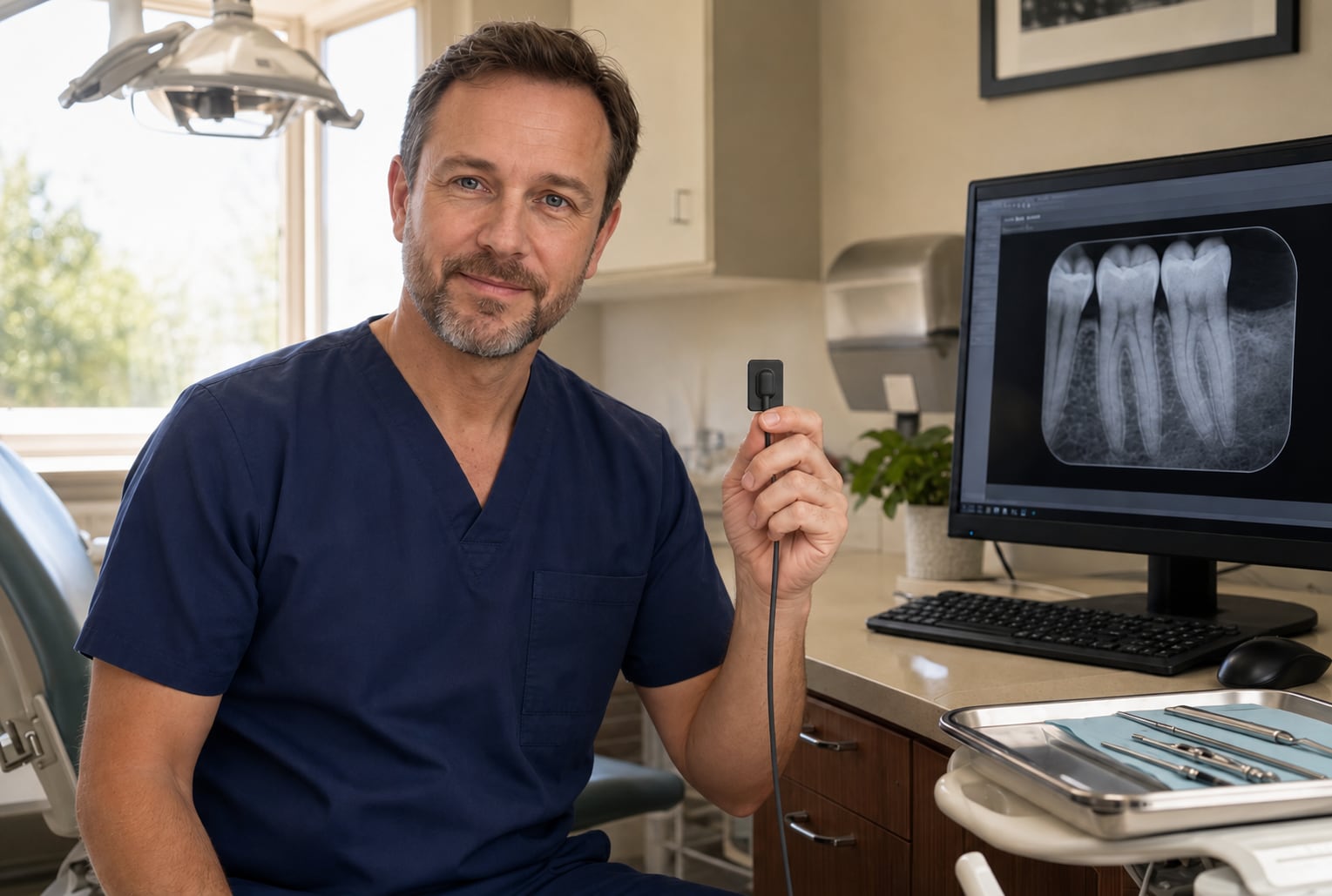
A small practice usually feels the cost of a bad technology decision faster than a large group does. If you are trying to choose the best intraoral sensor for small practice settings, the question is not just which sensor takes a sharp image. It is which sensor fits your operatories, your team, your software environment, and your budget without creating friction every day.
That distinction matters. An intraoral sensor can look impressive on a spec sheet and still slow down exams, frustrate assistants, or add replacement costs that quietly erase the value of the original purchase. For a smaller office, where every operatory minute and every capital dollar counts, the right sensor is the one that improves diagnostic confidence while staying dependable in real-world use.
What makes the best intraoral sensor for small practice offices?
For most small practices, the best choice balances five things: image quality, patient comfort, durability, software compatibility, and total cost of ownership. If one of those is out of line, the system can become harder to justify.
Image quality is usually the first thing doctors ask about, and for good reason. You need clear, consistent radiographs for caries detection, endodontic evaluation, restorative planning, and patient communication. But image quality should be judged in context. A sensor that delivers excellent detail but requires frequent retakes because of awkward positioning is not really helping efficiency.
Patient comfort also carries more weight than many buyers expect. In a small practice, patients often see the same team repeatedly, and their experience influences case acceptance and overall satisfaction. A bulky sensor with squared edges may work, but it can create enough discomfort to make posterior images more difficult, especially with pediatric patients, patients with gag reflex issues, and smaller arches.
Durability is another major factor. Sensors live in a demanding environment. They are handled constantly, disinfected repeatedly, and exposed to drops, bites, and cable strain. A lower upfront price can be appealing, but if the sensor fails early or requires repeated repairs, the savings disappear quickly.
Software compatibility is where many purchases become more complicated than expected. A sensor should integrate cleanly with your imaging software and workflow. If your team has to work around driver issues, awkward image acquisition steps, or inconsistent communication between systems, the technology adds frustration instead of value.
Then there is the full financial picture. Small practices should look beyond purchase price and ask about warranty terms, replacement policies, training, support responsiveness, and how much downtime a failure could create.
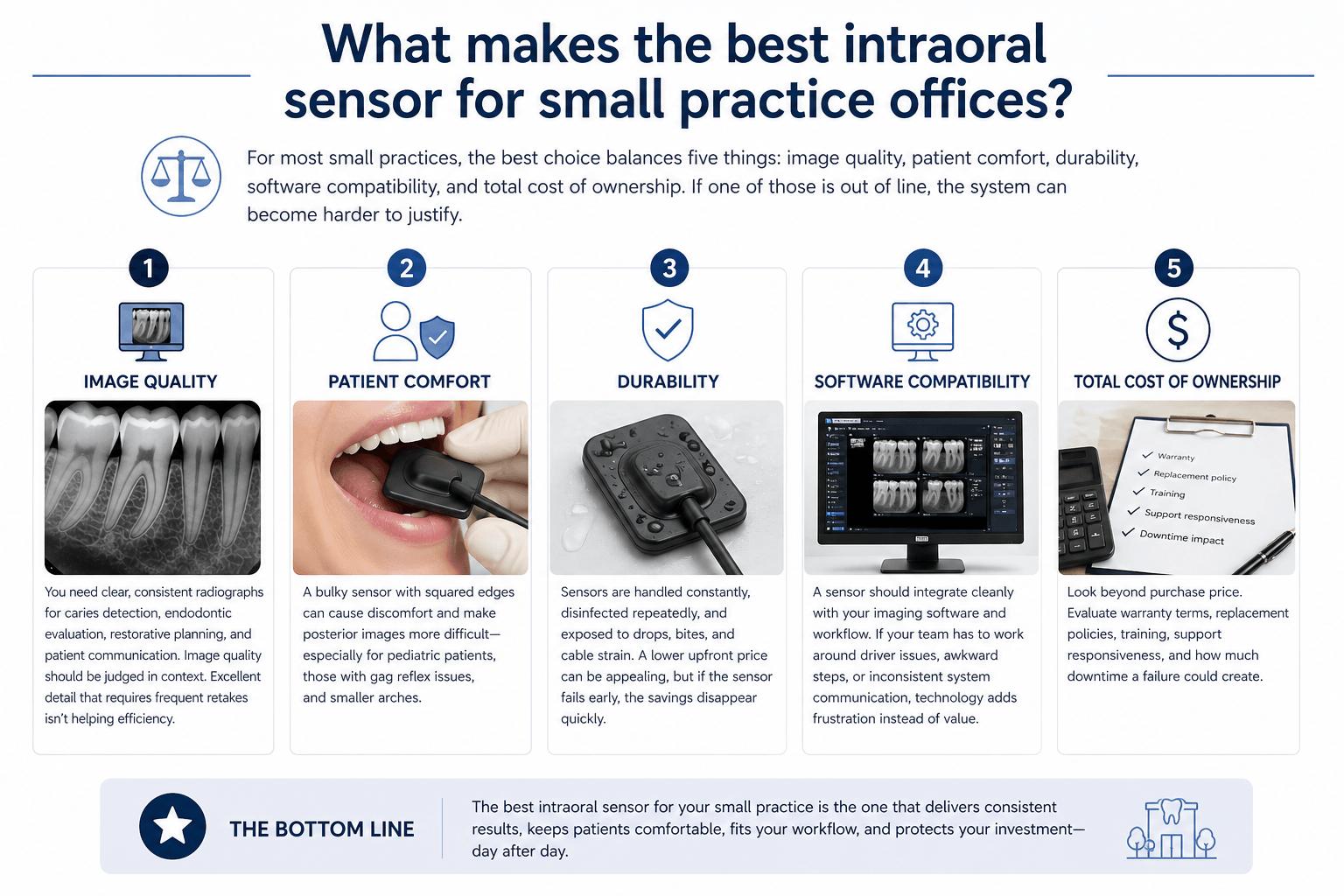 Choosing the ideal intraoral sensor for small practice offices involves balancing image quality, patient comfort, durability, software compatibility, and total cost of ownership, ensuring efficient workflow and patient satisfaction.
Start with workflow, not the brochure
The best buying process begins in the operatory. Look at how many providers will use the sensor, how many rooms need access, and whether your team captures a high volume of bitewings, posterior periapical, pediatric images, or endodontic series. Those details shape what “best” really means.
A single-doctor practice with one hygienist may prioritize one highly reliable sensor that moves easily between operatories. A busier office with multiple chairs may need two sensors to avoid bottlenecks. An office that does more endodontic or restorative diagnosis may place a premium on image sharpness and consistent positioning. A family practice may care more about comfort, size options, and ease of use across different patient types.
This is where small practices can make a smart move by resisting overbuying. You do not always need the most expensive sensor on the market. You need a sensor that your team will actually use well, every day, with minimal disruption.
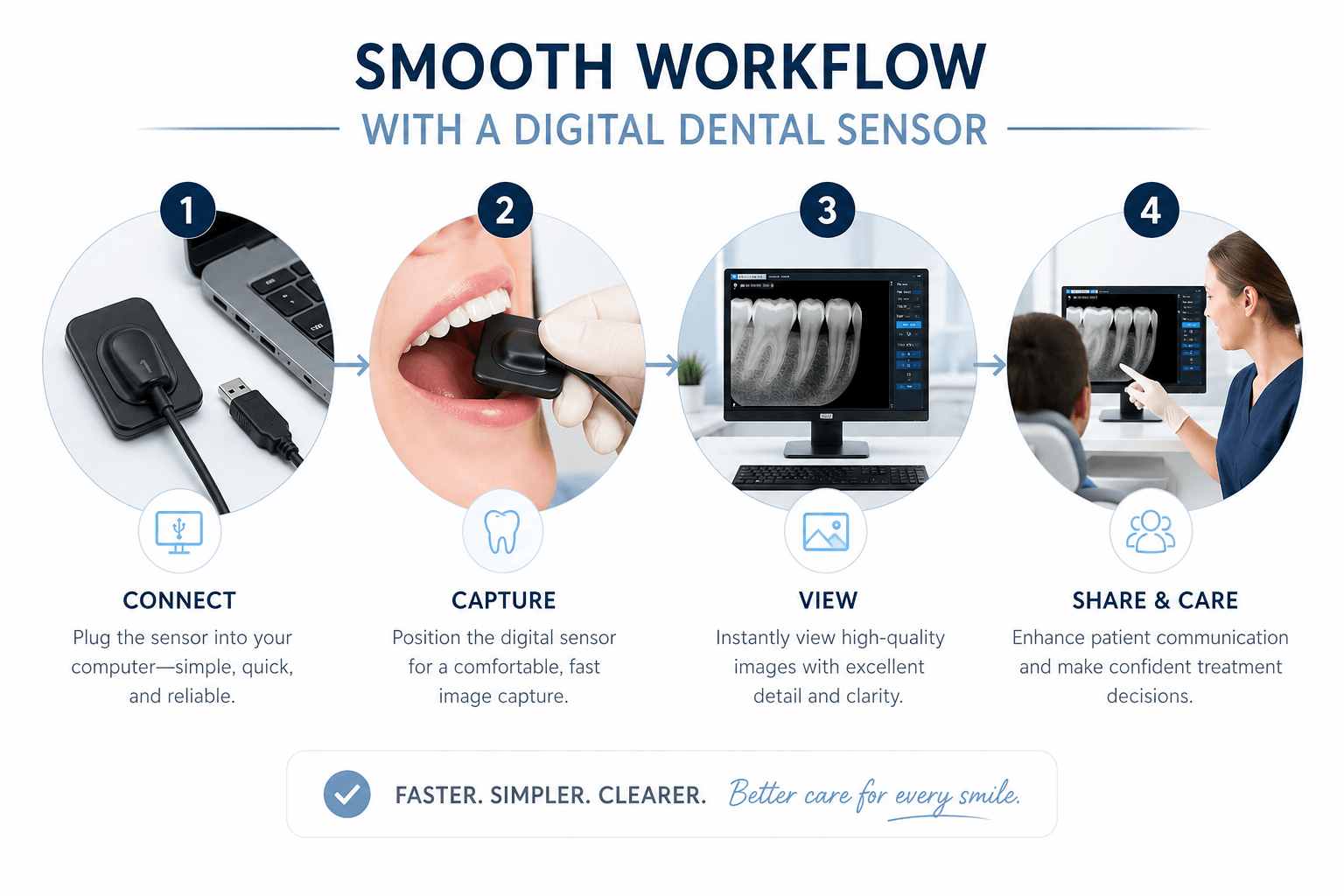 Enhancing patient care through a streamlined digital dental sensor workflow: connect, capture, view, and share for a superior dental experience.
Image quality matters, but consistency matters more
Most modern sensors can produce diagnostically useful images. The more useful question is how consistently they do it in your hands. Resolution numbers and marketing claims do not tell the full story.
What usually separates a strong sensor from an average one is the combination of detail, exposure latitude, and image processing that makes anatomy easy to interpret without constant adjustments. If the image appears sharp but requires frequent retakes because positioning is unforgiving, efficiency suffers. If software processing is too aggressive, clinicians may spend extra time adjusting contrast and brightness.
For small practices, consistency often delivers a better return than chasing the highest technical spec. A sensor that helps assistants capture predictable images quickly can improve schedule flow just as much as it improves diagnosis.
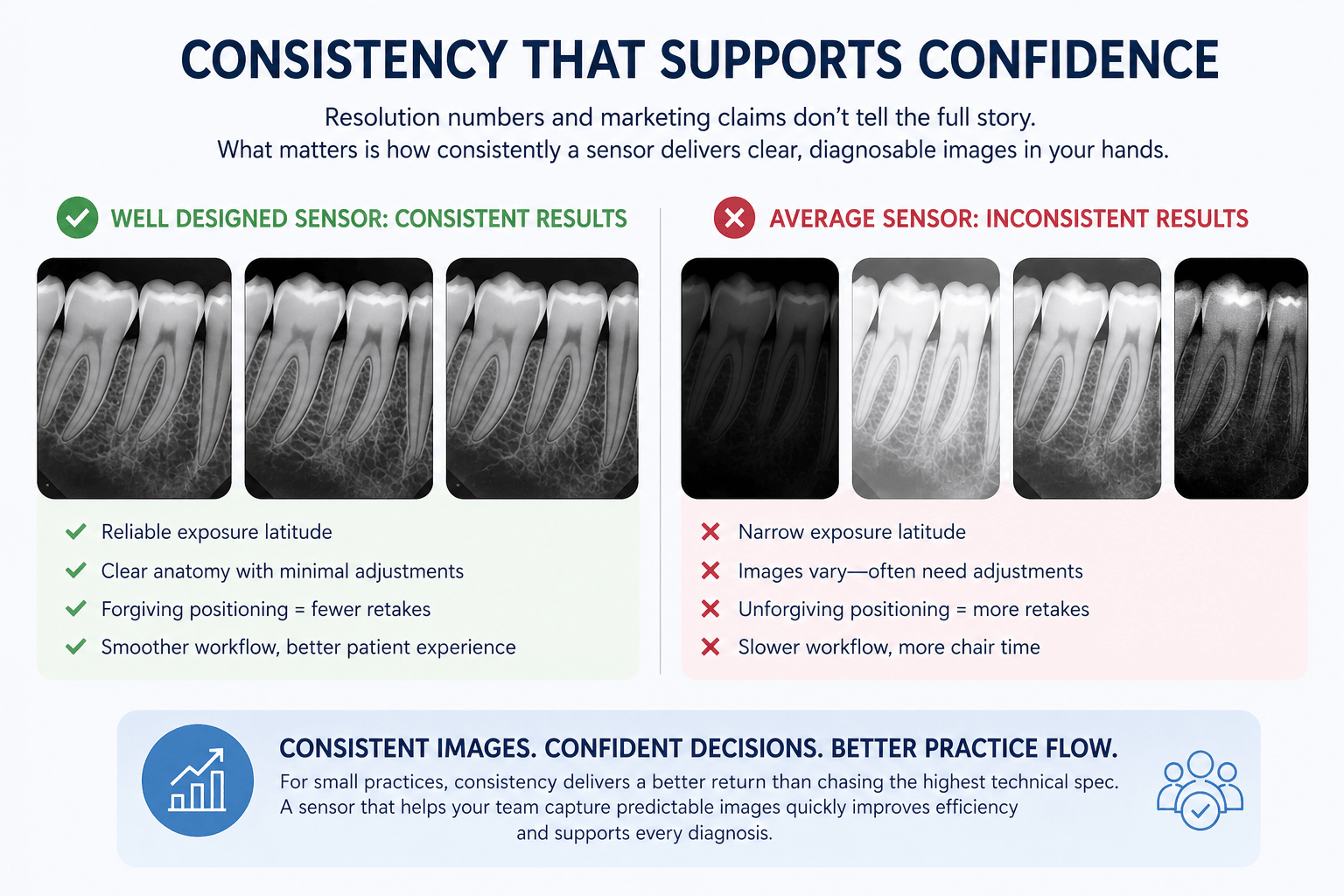 Effective X-ray sensor consistency enhances diagnostic accuracy by delivering clear, reliable images with minimal adjustments, improving workflow and patient experience.
Sensor size and comfort have a direct effect on productivity
One of the most overlooked parts of choosing the best intraoral sensor for small practice use is physical design. The sensor has to fit patients comfortably enough that the team can capture images without a fight.
Most general practices evaluate at least a size 1 and size 2 option, depending on patient mix. If your office sees children or many patients with smaller mouths, that flexibility can reduce retakes and improve the appointment experience. Rounded edges, a slimmer profile, and thoughtful cable placement make a real difference when the sensor is used all day.
It also helps to think about positioning systems. Even a good sensor becomes harder to use if holders are awkward or not well supported. When evaluating options, consider the complete imaging setup rather than the sensor alone.
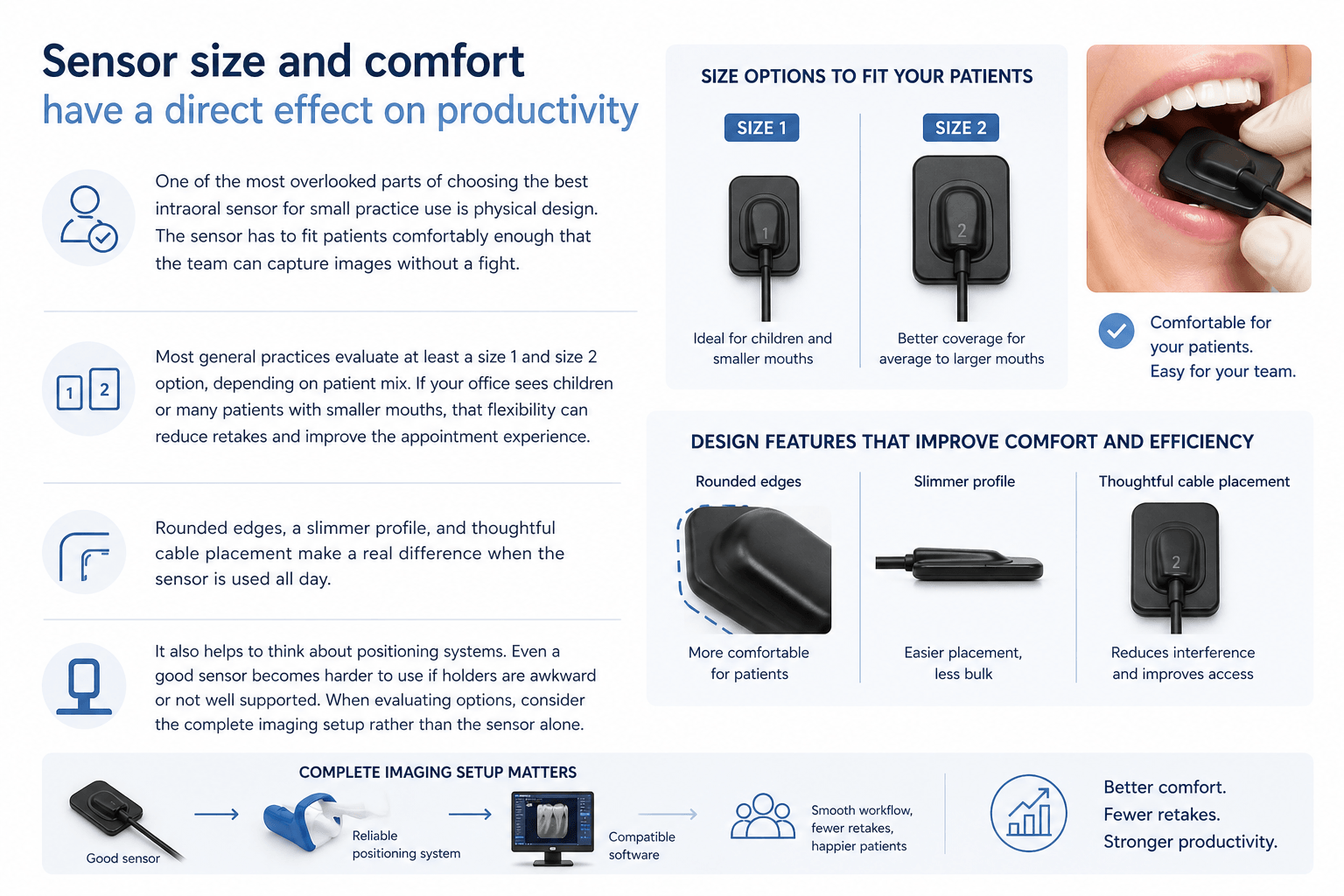 Choosing the right sensor size and design enhances patient comfort and increases productivity by reducing image retakes and improving the appointment experience.
Durability and warranty should influence the decision more than price alone
A small practice rarely has much room for avoidable downtime. If your only sensor fails, hygiene and doctor schedules can feel the impact immediately. That is why durability is not a secondary feature. It is a core buying criterion.
Ask practical questions. How is the cable reinforced? What kind of housing protection is built in? What does the warranty actually cover? Is there a loaner or replacement path if the sensor needs service? How quickly can support respond?
A cheaper sensor can become the more expensive choice if it leads to repair costs, lost production, and staff frustration. On the other hand, a premium-priced sensor only makes sense if the vendor support, warranty structure, and long-term performance justify the investment.
Software compatibility can make or break adoption
Even an excellent sensor underperforms if it does not work cleanly with your existing systems. Before buying, verify compatibility with your practice management software, imaging platform, and workstation setup. Do not assume all integrations are equally smooth.
This is especially important in smaller offices where there may be limited in-house IT support. Installation should be straightforward, image acquisition should be intuitive, and the team should not have to memorize workarounds. Training also matters here. A system that is easy to learn and well supported will be adopted faster and used more consistently.
That is one reason many practices benefit from working with a technology partner rather than simply ordering hardware. Companies such as Dental TI focus on implementation, training, and ongoing support, which can reduce risk and help practices get real value from the purchase.
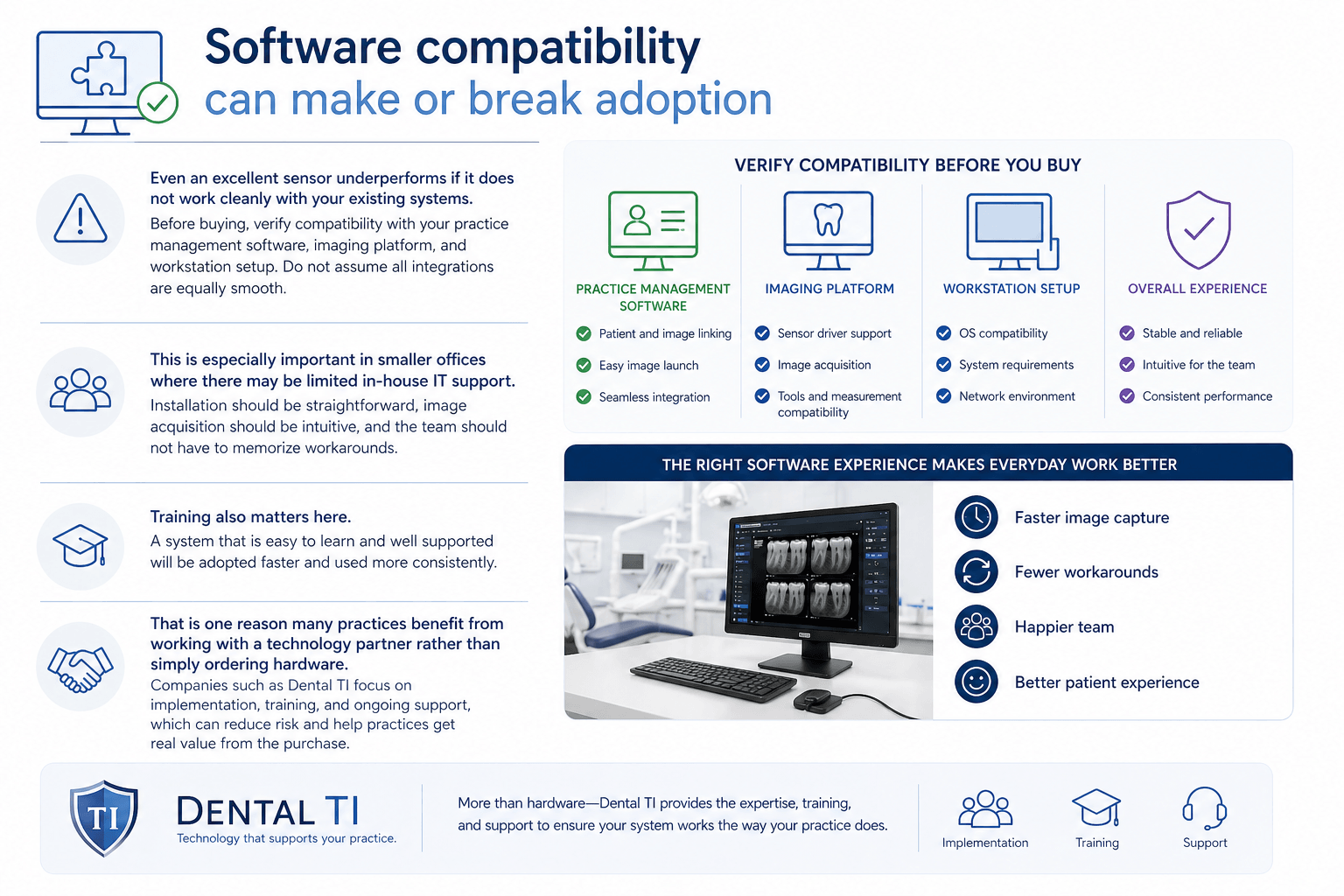 Ensuring sensor compatibility in dental software is crucial for seamless system performance, enhancing user experience and patient care. Proper integration with practice management software, imaging platforms, and workstations mitigates the need for workarounds and facilitates fast adoption, particularly in smaller offices. Implementing through a knowledgeable partner like Dental TI ensures stability, reliability, and consistent performance.
Should a small practice buy premium or budget?
It depends on the practice’s goals, patient volume, and tolerance for risk.
A premium sensor may be the right move if your office depends heavily on digital imaging efficiency, wants stronger image consistency, and values higher-touch support and longer-term reliability. In many cases, the extra upfront cost is justified by smoother workflow, fewer retakes, and lower disruption over time.
A budget-oriented option can make sense for a startup, a lower-volume office, or a practice replacing a failing system under tight capital constraints. But budget products should still be evaluated carefully for warranty quality, software support, and replacement risk. Saving money at purchase is only helpful if the system remains dependable.
Small practices should think in terms of return on investment, not sticker price. If a better sensor saves chair time, reduces retakes, improves patient experience, and avoids service interruptions, the financial case often becomes clearer.
A practical way to narrow the field
When comparing sensors, focus on a short list of real buying questions. How comfortable is it for your average patient? How easy is it for assistants and hygienists to position? Does the image quality hold up across common exams? Will it integrate smoothly with your current software? What does support look like after installation?
If possible, involve the people who will use it most. Doctors may prioritize diagnostic clarity, while assistants and hygienists often spot workflow issues immediately. Their input can help you avoid choosing a sensor that looks strong on paper but creates friction in practice.
It is also wise to compare support models as closely as product specs. In a small office, responsive training and service often have as much practical value as the hardware itself
.
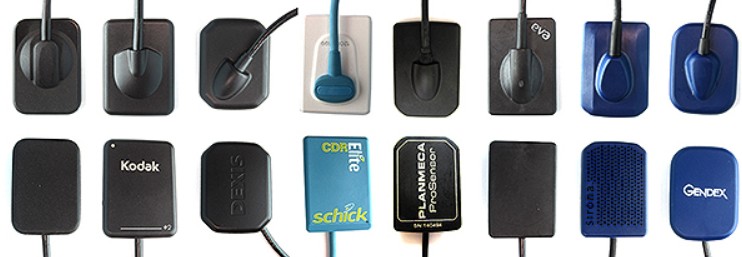 An array of various dental sensors showcasing their diverse shapes and sizes, highlighting differences in design and brand specificity.
The right sensor is the one your practice can fully use
There is no single best sensor for every office. The best intraoral sensor for small practice environments is the one that fits your clinical needs, your team’s workflow, your patient population, and your long-term operating model.
That usually means choosing for reliability and fit, not just for marketing claims. A well-matched sensor helps your team work faster, supports stronger diagnosis, and protects production by reducing avoidable downtime. When you evaluate the full picture, not just the image sample, you make a better investment decision.
If you are weighing options, think less about buying a device and more about building a dependable imaging workflow. That mindset usually leads to a better choice - and fewer regrets a year from now.
Choosing the right intraoral sensor isn’t about chasing specs—it’s about finding a system that works reliably in your practice, with your team, and for your patients day in and day out.
If you’re weighing options or unsure how different sensors will actually perform in your workflow, it’s worth having a conversation. Dental TI helps practices look beyond the brochure—focusing on real-world usability, integration, training, and long-term value so you get a solution that actually improves efficiency and patient care.
If you’re considering an upgrade or adding sensors, reach out to Dental TI and ask about current spring promotions. It’s a good opportunity to get the right technology in place while making the numbers work for your practice.