
PreXion
Evolve 3D (SFOV)
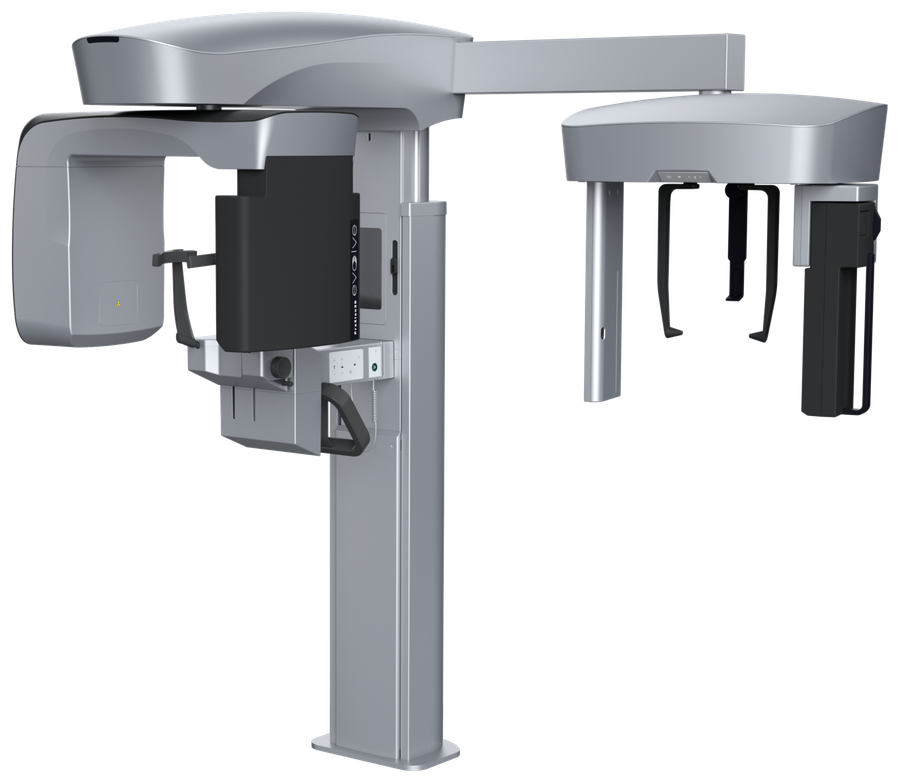
PreXion's entry-point small field of view CBCT — 2D panoramic plus 3D volumetric imaging in one compact system, ceph-upgradable.
Serving dentistry since 2003
Installation, training & expert support included
About the Evolve 3D (SFOV)
The Evolve 3D (SFOV) is PreXion's small-field-of-view cone beam system, built for practices that want panoramic and targeted 3D imaging — implant sites, single-tooth endodontics, third molars — without paying for a large-FOV unit they don't need. It's also PreXion's entry point into 3D. The Evolve ships as a 2D panoramic unit that can be configured — at the time of purchase, or later as a field upgrade to the same installed hardware — into PAN + CBCT (SFOV) or PAN + CBCT + CEPH (SFOV). A practice that only needs panoramic imaging today isn't locked out of adding cone beam or cephalometric capture down the road; PreXion's own spec sheet lists the 3D upgrade from the base 2D unit as a standard option, not a special order. It runs on the same PreXion Image software platform as the rest of the current PreXion line, with Patient Motion Correction (PMC) and 3-level Metal Artifact Reduction (MAR) built in, and four resolution modes (LD/STD/HD/UHD) so the dose and detail can be matched to the exam. Within PreXion's current CBCT lineup, the Evolve is the starting point, not the largest field of view: its three FOVs (5×5, 9×6, 9×9 cm) sit at the small end of what PreXion also offers on the Excelsior Mid, Max, and Endo. Practices that need full-arch or larger coverage move up to the Excelsior line; the Evolve is built for the practice that wants reliable panoramic imaging plus single-arch, single-site 3D on one combo system.
- FOVs: 5×5 cm, 9×6 cm, 9×9 cm (50×50mm to 90×90mm)
- Voxel size: 75–400 µm, isotropic (UHD Endo mode)
- Focal spot: 0.5mm
- Tube: 60–120 kV, 3.2–16 mA
- Patient Motion Correction (PMC) and 3-level Metal Artifact Reduction (MAR)
- Resolution modes: LD / STD / HD / UHD
- Cephalometric imaging available as an option (Evolve 3D CEPH)
- Software: PreXion Image (1 server + 5 clients license)
- Supply voltage: 110/127/220/240 AC
- Configurable as PAN, PAN + CBCT (SFOV), or PAN + CBCT + CEPH (SFOV) — the 3D and CEPH additions are field upgrades to the same installed unit, not a trade-in
- Panoramic image programs: adult, infant/children's, fast pan, bitewing, maxillary sinuses, TMJ, and enhanced ortho, plus 41-slice multi-slice navigation for isolating a specific structure
- Evolve Smart Contrast — a 2D-only algorithm that adjusts contrast region-by-region across the panoramic image for a more even, lower-noise result
- 3-axis movement system (two orthogonal directions plus rotation) for flexible radiographic positioning and cutting-plane thickness control
- Cephalometric scan time: 4.1–16.5 seconds in Standard Mode, 2.5–10 seconds in Fast Mode
- Optional modules: DICOM Worklist/PACS connectivity and TWAIN acquisition (Prexion Evolve Connection), 2D implant simulation (Prexion Evolve IP), manual cephalometric tracing — McNamara, USP, Ricketts, Steiner, Rocabado, Tweed, and other protocols — and AI-assisted cephalometric analysis
- Footprint: 1350mm (53.15 in) wide × 1110mm (43.7 in) deep, 2460mm (96.85 in) tall
New to CBCT, or narrowing down field of view, voxel size, and cost? Read the complete guide to dental CBCT before you decide.
Under the hood
Evolve 3D (SFOV) technology
Patient Motion Correction (PMC)
PMC automatically detects and corrects for the small, often unnoticed movements patients make mid-scan, rather than requiring a full retake when a scan shows blur. That keeps exam quality consistent and cuts down on repeat exposures — useful with kids, anxious patients, or long high-resolution captures.
Metal Artifact Reduction (MAR)
MAR processes out the streaking and distortion that gutta-percha, implants, full-arch prostheses, and metal restorations cause in a CBCT volume. It runs at three selectable correction levels, and because it's a reprocessing step rather than a rescan, you can go back and try a different level on an existing volume without exposing the patient again.
120 kV Tube Voltage
The Evolve's 3D tube operates up to 120 kV, using specialized filtration to raise the average energy of the beam. That reduces beam-hardening artifacts near dense structures and filters out more of the low-energy photons that add noise and patient dose without adding diagnostic detail.
Resolution Modes (LD/STD/HD/UHD)
Four acquisition modes — Low Dose, Standard, High Definition, and Ultra High Definition — let exposure time and voxel size be matched to the exam instead of using one setting for everything. A screening scan can run in LD for a lower dose, while an endodontic case can step up to UHD for finer voxel detail.
Evolve Smart Contrast
A 2D-only processing algorithm built into the Evolve's panoramic software. It evaluates and adjusts contrast independently across different regions of the panoramic image, rather than applying one global curve, which keeps detail visible in both denser and thinner areas of the arch without the image looking noisy or flat.
Evolve 3D (SFOV) questions, answered
What field of view options does the PreXion Evolve 3D have?
The Evolve 3D (SFOV) offers three fields of view: 5×5 cm, 9×6 cm, and 9×9 cm — sized for single-implant, single-arch, and full-arch small-FOV diagnostics.
Can the PreXion Evolve 3D capture cephalometric images?
Yes, as an option — the Evolve 3D CEPH configuration adds cephalometric capture to the same unit.
What is the voxel size and focal spot of the PreXion Evolve 3D?
The Evolve 3D has a focal spot of 0.5mm and an isotropic voxel size from 75 to 400 µm depending on resolution mode, down to its highest UHD Endo setting.
What software does the PreXion Evolve 3D run?
PreXion Image, licensed for one server and five clients, with Patient Motion Correction (PMC), 3-level Metal Artifact Reduction (MAR), and four resolution modes — LD, STD, HD, and UHD. Every scan also exports in the standard DICOM format, so it's compatible with any DICOM-compliant viewing or planning software your practice already uses, not just PreXion Image.
What is included when I buy the PreXion Evolve 3D from Dental TI?
Every PreXion Evolve 3D comes with manufacturer-backed installation and support from PreXion. Dental TI adds another layer on top: site planning, integration with your practice's imaging software, on-site team training with remote training also available, and expert remote and on-site support of our own. Dental TI has served dentistry since 2003 from Carmel, Indiana.
Does correcting metal artifacts on the Evolve 3D require rescanning the patient?
No. The Evolve 3D's 3-level Metal Artifact Reduction lets you reprocess the same scan at a different correction level after the fact — for gutta-percha, implants, or metal restorations — without a new exposure.
What computer do I need to run the Evolve 3D?
PreXion's minimum recommendation for the Evolve 3D's acquisition workstation: Windows 10 64-bit Professional, Intel Core i7 (10th gen or newer, 12 MB cache, 4.0 GHz+), 16 GB RAM, an Nvidia GeForce RTX 4060 8GB or better, a 500W+ power supply, 1TB+ storage, a 1920×1080 monitor, and a dedicated Gigabit Ethernet adapter.
Does installing the Evolve 3D require a certified technician?
Yes — PreXion requires equipment assembly to be performed by a certified technician, and the shipping packaging must stay sealed until they arrive; opening it early voids the manufacturer's warranty. Dental TI coordinates this as part of installation.
Can the PreXion Evolve 3D be upgraded after purchase?
Yes. The Evolve platform is built to be upgraded on the same installed hardware: a base 2D panoramic unit can be field-upgraded to add cone beam (PAN + CBCT SFOV), and cephalometric capture (PAN + CBCT + CEPH SFOV) can be added at the same time or later. PreXion's own spec sheet lists the 3D upgrade as a standard option on the 2D unit, not a special order or trade-in.
What's the difference between the PreXion Evolve 3D and PreXion's Excelsior line?
Field of view and role in the lineup. The Evolve 3D tops out at a 9×9 cm field, the smallest tier PreXion also offers on the Excelsior Mid, Max, and Endo — but the Excelsior line goes further, up to 16×9 cm on the Mid and 16×21 cm on the Max for full-arch and cranial coverage, and down to a 0.2mm focal spot on the Endo for higher-resolution endodontic detail. The Evolve is PreXion's combo entry point — panoramic plus single-arch, single-site 3D in one upgradeable system — while the Excelsior line is built around a larger or higher-resolution CBCT as the primary purpose of the unit.
How does Patient Motion Correction work on the Evolve 3D?
PMC runs automatically during 3D acquisition, detecting the small movements a patient makes mid-scan and correcting for them in the reconstructed image rather than requiring a retake. It's built into the Evolve's imaging pipeline by default — there's no separate step to turn it on.
What panoramic exam types can the Evolve 3D capture?
Adult, infant/children's, fast pan, bitewing, maxillary sinus, TMJ, and enhanced ortho panoramic programs are all standard, along with 41-slice multi-slice navigation for scrolling through the arch to isolate a specific structure.
What cephalometric analysis protocols does the Evolve 3D CEPH support?
Manual tracing supports named protocols including McNamara, USP, Ricketts, Steiner, Rocabado, and Tweed. An optional AI-assisted diagnostic module can also apply these protocols automatically to speed up complex analyses — the same approach PreXion uses on the Excelsior Max CEPH.
Is the Evolve 3D (SFOV) right for your practice?
Talk it through with an advisor who installs these machines every week — including the ones we'd steer you away from.