
Wireless Dental Sensors: What Changed in 20 Years
· David Hanning
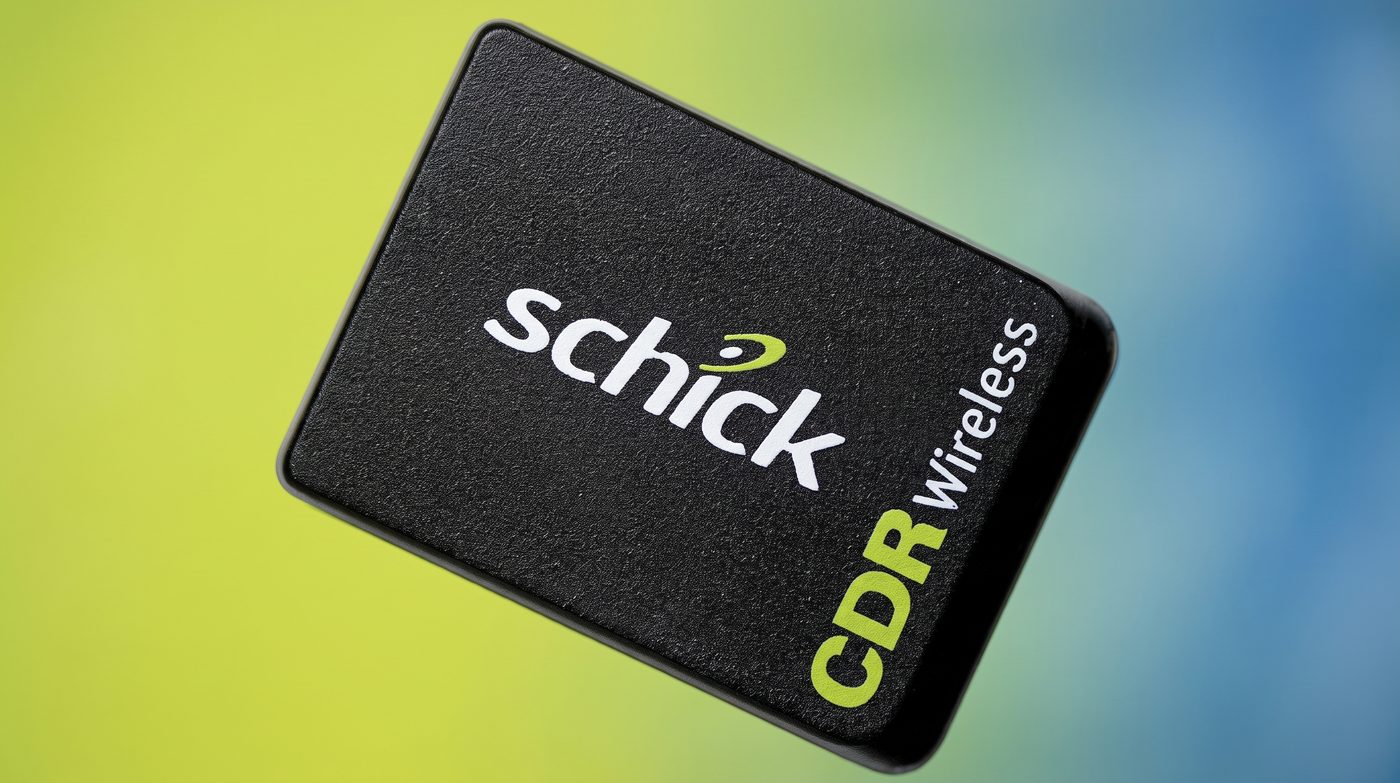
DC-Air™ isn’t the first time someone tried to build a wireless dental x-ray sensor. Dentistry tried this once before, in the early 2000s — and it didn’t stick. Understanding why is the best way to understand what DC-Air™ actually is: not a new idea, but an old idea finally built with the right parts.
The first attempt
Schick® Technologies — the company that brought the first widely used digital intraoral sensor to market in the early 1990s — released a wireless version of its CDR® sensor in the early 2000s. Schick® marketed it as the world’s first wireless direct digital radiography system, and on paper it delivered what that promised: no cable running from the sensor to the computer.
The sensor communicated over a proprietary FM radio link in the 2.4 GHz band, with three user-selectable channels so nearby practices or operatories wouldn’t step on each other’s signal. A receiver connected to the PC over USB, picking up the radio signal and passing the image through. It ran on a battery pack, and it auto-powered-off after about 15 minutes of inactivity to conserve it.
It worked. It just didn’t work well enough to last.
Why it didn’t stick
The clearest account of what went wrong doesn’t come from a competitor or a review — it comes from the patent behind DC-Air™ itself. Filed by Athlos Oy, the Finnish engineering firm that designed DC-Air™, the patent’s background section lays out exactly what the earlier generation of wireless sensors got wrong:
The wireless link wasn’t reliable enough. In the patent’s own words, “wireless link is not reliable and data is lost all too often, creating the need of additional exposure.” A dropped signal on a wired sensor is a rendering glitch. A dropped signal on a wireless sensor with the patient still in the chair means shooting the x-ray again — the opposite of what going wireless was supposed to buy you.
The sensor was bulky. It still used a scintillator with a thick fiber-optic plate — the same indirect-conversion technology as a wired sensor — and then added wireless electronics and a battery pack on top of that. Every part of that stack added size and power draw that a wired sensor never had to carry.
The battery was a consumable, not a feature. It ran on a single-use battery pack good for a handful of exposures before it had to be thrown out and replaced. Dental supply catalogs still list “CDR® Wireless Battery Pack” in 10-packs — a small detail that tells you how routinely offices went through them.
The most honest evidence that this generation of wireless didn’t work: Schick® itself, now part of Dentsply Sirona, moved on. Its newest sensor, the Schick® AE, is wired — following the Schick® 33 and Schick® Elite, both past models before it. The company that built the first wireless dental sensor went back to a cable, and stayed there.
What had to change
DC-Air™ was designed by Athlos Oy and cleared by the FDA on July 22, 2021, brought to the US market by Freedom Technologies Group. Between Schick®‘s attempt and DC-Air™, roughly two decades passed — and the three things that sank the first attempt are the three things that changed.
Wireless transmission. Proprietary FM radio gave way to Bluetooth® Low Energy — a mature, standardized protocol built for exactly this kind of short-range device link, with retransmission handling built in. DC-Air™ also holds each capture in a 4 MB onboard buffer, so an image is never lost waiting on the connection the way Schick®‘s was.
Low energy on the sensor. DC-Air™‘s single-crystal direct-conversion silicon detector does away with the scintillator and fiber-optic plate entirely — there’s simply less hardware to power. Pairing that with Bluetooth Low Energy hardware, designed from the ground up for small battery-powered devices rather than adapted from general-purpose radio, cuts the power budget further still.
Battery life. DC-Air™ runs on a rechargeable battery good for 150+ radiographs per charge, recharging in under a minute on its docking station. Nothing about it is disposable, and nothing about it needs restocking.
Where that leaves “wireless” today
None of this means every sensor marketed as wireless today is doing what Schick® tried to do. Some products described as wireless are phosphor storage plates — passive plates that get scanned in a separate reader after the exposure, not a powered sensor transmitting anything in real time. Others are conventional sensors that still run a USB cable from the sensor to the PC, with wireless in the name but not in the hardware.
If you’re evaluating a sensor described as wireless, the one question worth asking is the same one that separates Schick®‘s attempt from DC-Air™: is the sensor itself cordless during the actual exposure, or does the cable just move somewhere less visible? DC-Air™‘s FAQ covers this distinction directly, along with the rest of what changed technically since the last time dentistry tried this.
If you’re weighing a wireless sensor for your practice and want the full picture, DC-Air™ has the specifications, clinical evaluation scores, and image comparisons in one place — or you can talk to Dental TI directly about whether it fits your workflow.