
PreXion vs. Morita vs. Owandy vs. ACTEON: Panoramic Brands
· David Hanning
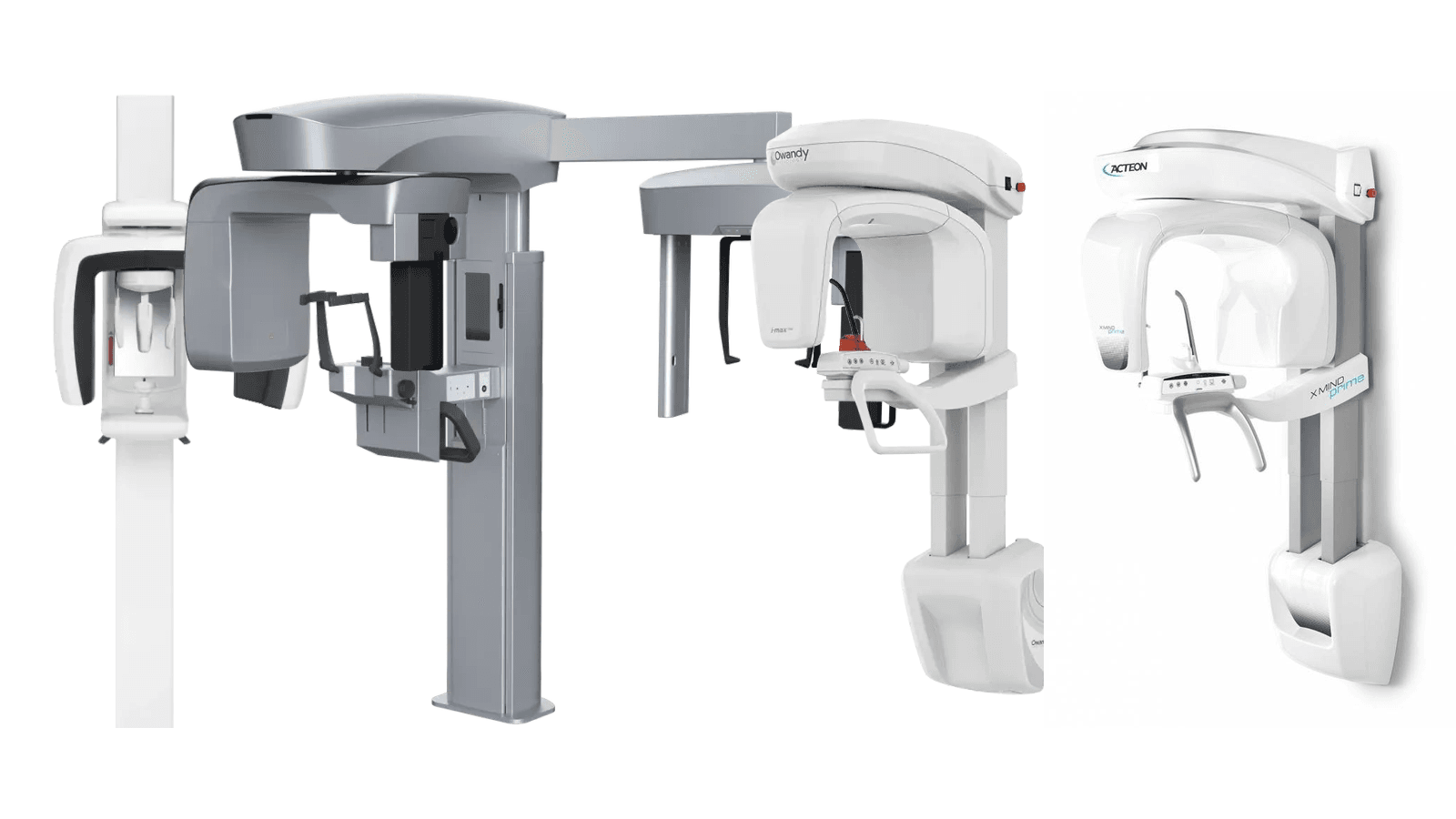
Panoramic Is Not a Commodity Decision
Most practices shop panoramic X-ray units the way they shop toner: whichever one is in stock, whichever one the rep pushes hardest. That approach misses real differences between brands that show up years after the purchase, not on install day.
Dental TI carries seven panoramic SKUs across four brands: PreXion, J. Morita, Owandy, and ACTEON. Put side by side, they split on four practical questions. Does the unit need floor space or can it hang on a wall? Does it come with a cephalometric arm, or can one be added later? Can the same gantry be upgraded to full CBCT down the road, or is panoramic as far as it goes? And how much control do you get over dose and exposure speed for pediatric or low-dose cases?
None of those questions have a universally correct answer. They depend on your ceiling height, your ortho referral volume, and whether 3D is a five-year plan or a maybe-someday. Working through each brand’s real differentiators makes the tradeoffs clearer.
PreXion: One Gantry, Built to Grow Into 3D
The PreXion Evolve 2D is the panoramic configuration of the same Evolve gantry PreXion sells as a full 3D CBCT system. That’s the headline: it’s not a separate panoramic-only chassis that happens to share a brand name. It’s the identical hardware platform, sold configured for 2D, with a genuine field upgrade to CBCT later — no trade-in, no reinstall, no swapping the unit out for a different one when the practice is ready for volumetric imaging.
On the imaging side, Evolve 2D uses 41-slice multislice navigation, meaning you page through the panoramic volume rather than being stuck with one flat, fixed layer — useful when overlapping anatomy obscures something on a standard single-plane pan. Evolve Smart Contrast adjusts contrast per anatomical area automatically, instead of applying one global curve across a jaw that has wildly different densities from the ramus to the incisors. A cephalometric arm is available as an option for practices doing ortho work now or later.
For a practice that knows 3D is somewhere on the roadmap but isn’t ready to write that check today, Evolve 2D is built specifically for that in-between phase. That same field-upgrade logic shows up again in J. Morita’s lineup, with a different tradeoff attached.
J. Morita: Two Units, Two Different Bets
J. Morita’s panoramic line splits into a unit built for the long game and one built to do panoramic well and nothing else.
The Veraviewepocs 2D is Morita’s version of the same upgrade story as PreXion: panoramic now, optional ceph, and a path to full 3D on the same platform later. Exposure settings run 60–90 kV and 1–10 mA, with a standard pano taken in 7.4 seconds on fine high-speed mode or 15 seconds on super fine for more detail. Cephalometric exposures are fast — 4.9 seconds lateral, 4.1 seconds PA. The program list is deep: standard and pediatric panoramic modes, maxillary sinus, a 4-view TMJ program, Orthoradial Panoramic, and Shadow Reduction Panoramic for patients with dense anatomy or restorations that would otherwise blow out the image. Everything runs through Morita’s i-Dixel software.
The Veraview IC5 HD, by contrast, doesn’t upgrade to anything — it’s a dedicated panoramic unit, compact and lightweight at roughly 110 kg, with no ceph arm and no 3D path. What it offers instead is a real low-dose option: a 5.5-second quick-scan mode at 192 µm resolution for the lowest-dose exposure in the lineup, alongside a 10-second standard exposure at 96 µm for full diagnostic detail. That quick-scan mode is a genuine tool for pediatric patients or dose-conscious protocols, not a marketing bullet. It also carries a 3-year manufacturer warranty, longer than most of the units in this comparison.
The decision between the two Morita units comes down to whether you want optionality (Veraviewepocs 2D) or you know panoramic-only is the permanent answer and want the simplest, lightest box that does it well (Veraview IC5 HD). Owandy takes a similar segmented approach, but with three units instead of two.
Owandy: A Range From Lightest to Most Equipped
All three Owandy units run the same QuickVision software, which keeps the learning curve flat if a practice buys into more than one unit across locations. Beyond that, they’re built for three different jobs.
The I-Max Pro is wall-mounted with zero floor footprint and the lightest unit in this whole comparison at 62 kg. It runs 24 imaging programs covering adult and pediatric panoramic, TMJ, sinus, hemi-panoramic, and regional views, at 60–70 kV and 2–7.1 mA. It carries a 2-year standard warranty with an optional 5-year extended warranty on the sensor and generator. For a practice tight on operatory space that just needs solid panoramic coverage, this is the simplest entry point in the Owandy line.
The I-Max Ceph Pro is the ortho-ready end of the range. It uses a CMOS SUPER IGZO sensor and supports cephalometric formats from 18×24 up to 30×24 cm, including reduced-dose and carpus (skeletal age) programs — relevant for practices tracking growth in adolescent ortho patients. It runs a wider power range (60–86 kV, 2–12.5 mA) to cover both panoramic and larger ceph exposures, and it’s a floor-standing unit at 118 kg, with the same warranty terms as the I-Max Pro.
The I-Max Touch sits in between: no ceph arm out of the box, but built to add one later. It uses a CCD HD sensor with optical fibre at 10.4 lp/mm resolution and a high-frequency constant-potential generator, running 60–86 kV at 6–10 mA for panoramic and 6–12 mA for ceph exposures. Panoramic exposure takes 13.8 seconds; ceph takes 4.5 seconds. It offers 14 panoramic programs and 5 ceph formats once the arm is installed, on a floor-standing footprint of 106×127 cm.
Three units, three commitments: buy simple and wall-mounted, buy ceph-equipped now, or buy ceph-ready and add the arm when the case for it arrives. ACTEON’s single 2D unit takes a different approach — going deep on program variety instead of splitting into multiple SKUs.
ACTEON: The Deepest 2D Program Library in This Comparison
The X-Mind Prime 2D is wall-mountable and, program for program, has the broadest panoramic feature set of any single unit here. Beyond standard adult and child panoramic modes, it includes TMJ open and closed lateral views, maxillary sinus P-A, half panoramic left and right, a dedicated low-dose panoramic mode, frontal dentition, Ortho Rad panoramic, and bitewing left, right, and double programs — essentially covering panoramic, a chunk of extraoral bitewing work, and TMJ diagnostics in one unit.
The base panoramic detector is a CCD running at 48 µm pixel size (96 µm when binned for faster, lower-dose captures), at 60–70 kV. A cephalometric arm is available as an option, built around a CMOS flat panel with a CsI scintillator at 99 µm pixel size, running 60–86 kV with exposures up to 14.4 seconds. Like PreXion’s Evolve and Morita’s Veraviewepocs, the X-Mind Prime 2D has a clear upgrade path to ACTEON’s own X-Mind Prime 3D CBCT on the same platform. Everything runs through ACTEON’s AIS (Acteon Imaging Suite) software.
For a practice that wants one wall-mounted box to handle the widest possible range of 2D diagnostic views — without necessarily committing to ceph or 3D on day one — this is the deepest program library in the lineup.
Which One Fits Your Practice
If operatory space is the binding constraint and you want a wall-mounted unit with no floor footprint to plan around, the I-Max Pro or the X-Mind Prime 2D are the two to compare — both mount to a wall, and the choice between them comes down to program depth (X-Mind Prime 2D) versus the lightest hardware footprint (I-Max Pro).
If you’re already doing meaningful ortho volume and want cephalometric imaging built in now rather than added later, the I-Max Ceph Pro and the Veraviewepocs 2D both ship ceph-capable and cover a wide exposure range for adult and adolescent cases.
If 3D is on your roadmap but not funded yet, the field-upgrade units are the ones worth a longer look: the Evolve 2D, the Veraviewepocs 2D, and the X-Mind Prime 2D all sit on gantries or platforms that upgrade to their respective brand’s full CBCT system without a second full-price purchase.
If pediatric volume or minimizing dose per exposure is the priority, the Veraview IC5 HD’s 5.5-second quick-scan mode is the standout feature in this comparison — a dedicated low-dose setting rather than a general-purpose exposure turned down.
Comparison at a Glance
| Brand / Model | Mount | Cephalometric | Upgrades to 3D | Standout Feature |
|---|---|---|---|---|
| PreXion Evolve 2D | Floor | Optional arm | Yes | Same gantry as PreXion 3D CBCT; 41-slice navigation |
| J. Morita Veraviewepocs 2D | Floor | Optional arm | Yes | Shadow Reduction & Orthoradial Panoramic programs |
| J. Morita Veraview IC5 HD | Floor | None | No | 5.5s low-dose quick-scan mode; 3-year warranty |
| Owandy I-Max Pro | Wall | None | No | 62 kg, lightest unit; 24 imaging programs |
| Owandy I-Max Ceph Pro | Floor | Included | No | Ceph up to 30×24 cm with carpus (skeletal age) program |
| Owandy I-Max Touch | Floor | Arm-ready | No | CCD HD sensor at 10.4 lp/mm; 14 pano programs |
| ACTEON X-Mind Prime 2D | Wall | Optional arm | Yes | Deepest 2D program library incl. bitewing & TMJ |
Talk Through Your Setup
All seven of these units are worth comparing side by side rather than picking on brand reputation alone. The panoramic catalog has a full side-by-side comparison tool if you want to line up specs across all four brands directly.
If your practice is already leaning toward volumetric imaging rather than 2D, it’s worth looking at the CBCT lineup instead — several of the panoramic units above share a gantry with a CBCT counterpart from the same brand, so the right starting point depends on your timeline.
For a recommendation based on your operatory layout, ortho volume, and 3D plans, contact Dental TI and we’ll walk through which unit actually fits, not just which one’s in stock.