
PreXion vs. Morita vs. HDX Will vs. ACTEON: CBCT Brands
· David Hanning
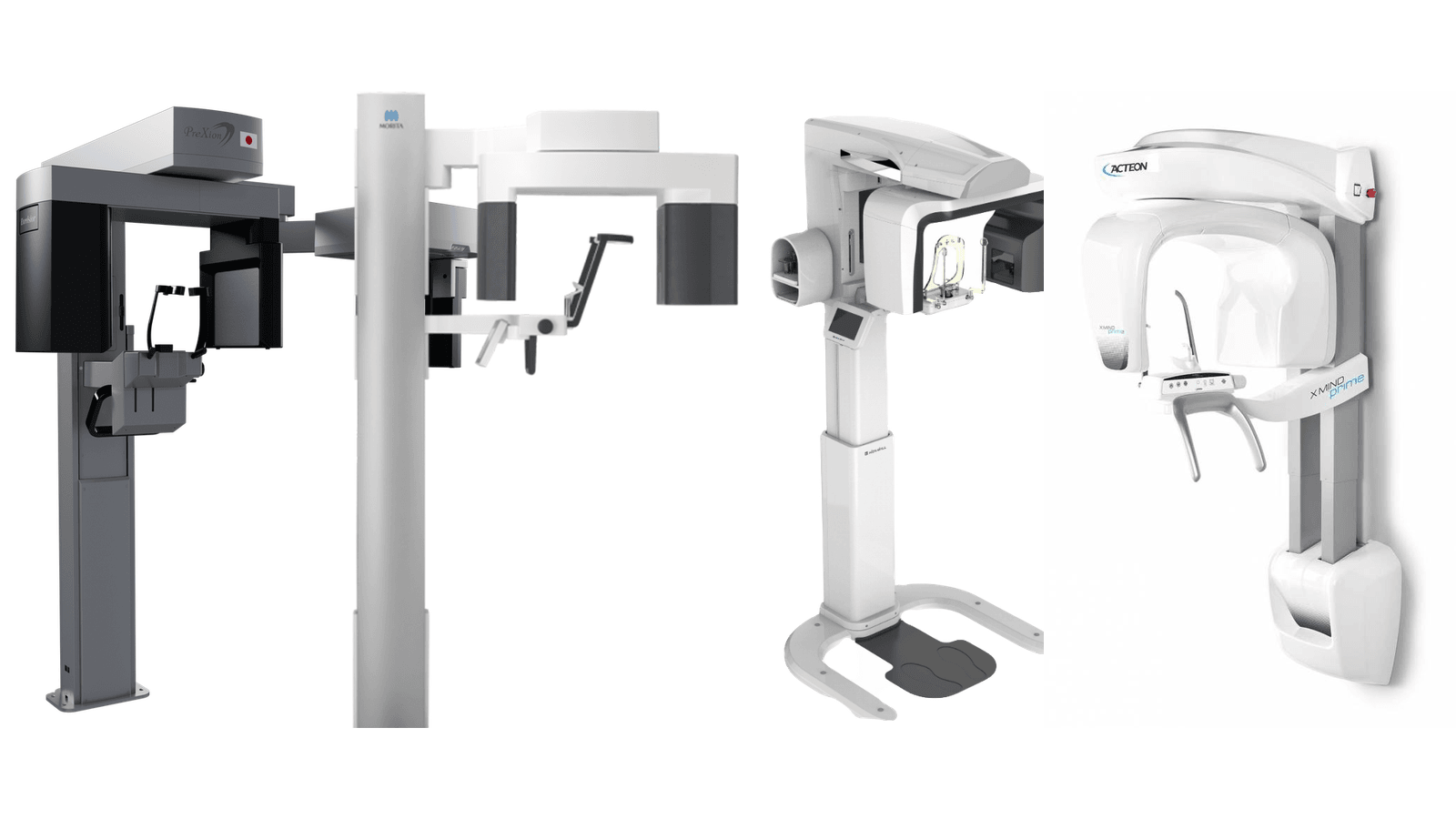
Every practice shopping for cone beam CT eventually asks the same question: which brand is best? The honest answer is that there isn’t one. Dental TI carries four CBCT lines, PreXion, J. Morita, HDX Will, and ACTEON, and we install all four because each one wins on a different set of priorities. A single-doctor endo practice, a full-arch implant office, and a group practice retrofitting a small operatory are not shopping for the same machine, even if they’re all shopping for “a CBCT.”
The real differences between these brands come down to field of view range, voxel resolution, software ecosystem, warranty coverage, and physical footprint. None of that shows up clearly when you’re comparing spec sheets one brand at a time. This guide puts all four side by side so you can match the machine to how your practice actually works, not the other way around.
PreXion: One Modular Platform, Small Field to the Largest in This Comparison
PreXion’s line is built around a single idea: buy the field of view you need today, and know the platform scales if your case mix changes. The Evolve 3D is the small-field entry point, covering 5×5, 9×6, and 9×9 cm fields with voxel resolution down to 75 µm, and a dedicated UHD Endo mode that pushes to 250 µm at the other end depending on the study. It’s the right size for a general practice doing implant planning, endo, and airway screening without needing a full-arch capture every time.
Step up to the Excelsior Mid and you get a mid-field unit that captures a full arch in one scan, up to 16×9 cm, with the same 75–400 µm voxel range. At the top of the line, the Excelsior Max extends to 16×21 cm, the largest field of view of any brand in this comparison, which matters for cranial and orthognathic cases. It also carries AI-assisted cephalometric tracing, 3D implant planning, airway volume analysis, STL conversion, and virtual endoscopy, features that put it closer to a surgical planning workstation than a standard imaging unit.
What sets PreXion apart isn’t just the range, it’s that every unit in the line, from the smallest Evolve to the largest Excelsior Max, ships with PMC motion correction and three-level Metal Artifact Reduction as standard, run through the same PreXion Image software. And for practices where endo is the primary driver, the Excelsior Endo is a genuinely dedicated unit: a 0.2mm focal spot (versus 0.5mm across the rest of the line) and voxels as small as 48 µm, with a horizontal beam source that reduces how much the system has to lean on software-based artifact correction in the first place. That’s the tradeoff to know going in: the Excelsior Endo doesn’t offer a ceph option, because it isn’t trying to be a general-purpose unit.
Where PreXion wins on range and modularity, J. Morita takes a different angle: proving its equipment is built to last.
J. Morita: Consistent, Stated Warranty Across Every Field-of-View Tier
J. Morita states the same 3-year manufacturer warranty across all four of its CBCT lines, the only brand here with that kind of consistency across its entire range rather than a single model. The 3D Accuitomo 170, now in its fourth generation, is the most flexible unit in the Morita line: nine selectable fields of view ranging from a tight ø40×H40mm up to a large ø170×H120mm, with a minimum voxel size of 80 µm and 14-bit grayscale depth. It runs on a 3-year manufacturer warranty and pairs with i-Dixel, with Exoplan available as optional implant-planning software.
The Veraviewepocs (X550) 3D R100 combines panoramic and cephalometric imaging in a single unit, with a field of view up to ø100×H80mm, 125 µm minimum voxel, and a dose reduction mode that cuts soft-tissue exposure to 60% of standard. Like the rest of the Morita CBCT line, it carries a 3-year manufacturer warranty — consistent, stated coverage rather than a case-by-case negotiation.
Morita’s newer Veraview (X800) line shares one platform across three field-of-view variants: the F40 for focused and endo work (ø40×H40 to ø40×H80mm), the R100 for full arch, TMJ, and sinus imaging (up to ø100×H80mm), and the F150 for full craniofacial coverage (up to ø150×H140mm). All three share the same core specs: 80 µm minimum voxel, 2.5 LP/mm resolution at 10% MTF, automatic beam angle switching between horizontal 3D capture and a 5-degree raised angle for 2D panoramic, i-Dixel software with optional Exoplan, and a 3-year warranty. That consistency across field-of-view tiers means a practice can pick the X800 variant that fits its case mix now and know the workflow, software, and support terms carry over if it upgrades later.
Morita’s strength is depth of software ecosystem and warranty consistency across its whole range. HDX Will takes a different bet: that the image quality of the machine you buy today should keep improving after you own it.
HDX Will: AI Reconstruction That Improves Through Software, Not Just Hardware
HDX Will’s differentiator is Cyoptix, its AI-driven image-reconstruction algorithm. Rather than treating image quality as fixed at the point of sale, Cyoptix improves through ongoing software updates, meaning a unit purchased today can see reconstruction quality gains later without a hardware swap. Both HDX Will units also run Precision MAR for metal artifact reduction and Auto Focus for panoramic capture.
The Dentri Max is the larger of the two, with a freely adjustable 12×9 cm field plus fixed 16×9 cm and 18×16.5 cm presets, 16-bit grayscale, and voxel resolution down to 100 µm. Cephalometric capture isn’t built into the base unit — it’s added via the optional cephalometric arm (the Dentri C Max configuration), with WillCeph Auto tracing available separately for automated landmarking if you need it. The Eco-X runs the same 16-bit, 60–90 kV, 4–10 mA platform and the same OnDemand3D and Will-Master software stack, at a smaller maximum field of view of 16×9 cm with voxel resolution down to 70 µm; its ceph capability similarly requires the Eco-X S hardware configuration rather than being a software-only add-on. It’s the right pick when a practice wants the same reconstruction engine and software experience as the Dentri Max but doesn’t need the largest available field.
Both HDX Will units share software across 3D and 2D: OnDemand3D handles 3D viewing and planning, Will-Master handles 2D panoramic viewing. For a practice that wants a machine whose image quality has a track record of software-driven improvement rather than a one-time hardware capability, HDX Will is the brand built around that argument.
Where HDX Will bets on software longevity, ACTEON solves a completely different problem: what to do when you don’t have the floor space for a CBCT at all.
ACTEON: The Only Wall-Mounted, Zero-Floor-Footprint Option
The X-MIND Prime is the standout choice for space-constrained practices, full stop. It’s wall-mounted with zero floor footprint, weighing a maximum of 148 lbs and occupying a compact 43.6-by-37.5-inch footprint on the wall. For a practice retrofitting an existing operatory, converting a room that was never designed to house floor-standing imaging equipment, or simply trying to preserve chair space, that physical form factor solves a problem none of the other three brands in this comparison address.
It’s not a stripped-down unit to get that footprint, either. The X-MIND Prime offers four field-of-view options, 50×50, 50×85, 93×85, and 120×100 mm, giving a real range from focused endo-style capture up to a field wide enough for full-arch and TMJ work. Voxel resolution goes down to 87.5 µm, and the system runs 16-bit grayscale for 3D capture and 12-bit for 2D panoramic. Ceph is optional, available as a Panoramic with CEPH or 3D/Pan with CEPH configuration, and when it’s included, cephalometric acquisition runs in 4.4 seconds. Software is ACTEON Imaging Suite (AIS), the manufacturer’s own imaging platform. It also carries the longest total warranty coverage in this comparison: 2 years standard plus a 3-year extension on the unit’s mechanics and electronics, with the sensor covered separately for 5 years or 14,000 exams, whichever comes first.
If wall-mounted, zero-footprint installation isn’t a constraint your practice has, the X-MIND Prime is still a capable general-purpose unit. But it’s the only one of the four brands built around that installation problem, and for the practice that has it, that’s usually the deciding factor before any other spec gets compared.
With each brand’s angle laid out, here’s how the numbers actually stack up side by side.
Side-by-Side: Max FOV, Minimum Voxel, and Standout Feature
| Brand / Model | Max Field of View | Minimum Voxel | Standout Feature |
|---|---|---|---|
| PreXion Evolve 3D | 9×9 cm | 75 µm (250 µm UHD Endo mode) | Modular small-field entry with 3-level MAR standard |
| PreXion Excelsior Mid | 16×9 cm | 75 µm | Full arch in one scan |
| PreXion Excelsior Max | 16×21 cm | 75 µm | Largest FOV in this comparison; AI cephalometric tracing, airway volume, virtual endoscopy |
| PreXion Excelsior Endo | Endo-focused (no ceph) | 48 µm | 0.2mm focal spot, horizontal beam source dedicated to endo |
| J. Morita 3D Accuitomo 170 | ø170×H120mm | 80 µm | Nine selectable FOVs, 3-year warranty |
| J. Morita Veraviewepocs 3D R100 | ø100×H80mm | 125 µm | 3-year warranty, pano + ceph in one unit |
| J. Morita Veraview X800 F150 | ø150×H140mm | 80 µm | Shared platform across 3 FOV tiers, 3-year warranty |
| HDX Will Dentri Max | 18×16.5 cm | 100–300 µm | Cyoptix AI reconstruction; ceph via optional arm (Dentri C Max) |
| HDX Will Eco-X | 16×9 cm | 70–200 µm | Same Cyoptix engine at a smaller max FOV |
| ACTEON X-MIND Prime | 120×100 mm | 87.5 µm | Wall-mounted, zero floor footprint; longest total warranty (5 yrs) |
How to Actually Choose Between Them
Spec comparisons only help once you’ve filtered by what your practice actually needs. Four questions do most of the work.
What field of view do you actually scan? If most of your CBCT use is single-tooth or localized endo work, you don’t need a large-field unit, and paying for one adds cost without adding diagnostic value. The Excelsior Endo or a small-field Morita configuration covers that case cleanly. If you’re doing full-arch implant planning regularly, you need a mid-field unit at minimum, PreXion’s Excelsior Mid, Morita’s Accuitomo 170, or HDX Will’s Dentri Max all clear that bar. If cranial, airway, or orthognathic imaging is part of your practice, only the Excelsior Max or Morita’s largest Accuitomo configuration have the field of view to cover it.
Does floor space or wall space drive the decision? If you’re retrofitting a room that can’t accommodate a floor-standing unit, the ACTEON X-MIND Prime is the only wall-mounted option in this lineup, and that alone may settle the decision before any other spec matters.
Do you need cephalometric capability now, or might you later? Ceph availability varies: it’s optional on the Evolve 3D, Excelsior Mid, and Excelsior Max but unavailable on the Excelsior Endo; standard on the Veraviewepocs 3D R100; available on the X800 line; one-shot on the Dentri Max; and optional with a 4.4-second acquisition on the X-MIND Prime. If ortho or orthognathic referrals are part of your growth plan, build ceph into the purchase now rather than assuming you can add it later.
How much does warranty term factor into your total cost of ownership? Morita states a consistent 3-year warranty across every model in its line, and ACTEON’s X-MIND Prime carries the longest total term here — 2 years standard plus a 3-year extension on the unit, with the sensor covered separately for 5 years or 14,000 exams. That’s a real, budgetable difference if you’re comparing total ownership cost rather than just the upfront decision.
What’s the Same Across All Four Brands
For everything that separates these four lines, they share real common ground. Every brand in this comparison runs some form of motion or metal-artifact correction as a core part of its imaging pipeline, PreXion’s PMC motion correction and 3-level MAR, Morita’s mature i-Dixel platform with optional Exoplan, HDX Will’s OnDemand3D and Will-Master with Precision MAR and Cyoptix reconstruction, and ACTEON’s AIS platform. None of these are bare-bones capture units; all four are built around software that corrects for patient movement and metal artifacts before a clinician ever reads the scan.
And none of that software locks you in. Every one of these units exports scans in the standard DICOM format, so whichever brand you land on, you’re not stuck using only the bundled viewer — the scan works with any DICOM-compliant viewing or treatment-planning software your practice already runs.
And every one of them installs, integrates, and gets supported through Dental TI. That’s the part that doesn’t change based on which brand fits your practice: the install process, the training, and the ongoing support line are the same regardless of which of the four you choose.
Talk to Us Before You Decide
The right CBCT for your practice depends on field of view needs, available space, ceph plans, and how you weigh warranty term against sticker price, not on which brand has the best marketing. If you want the fuller picture on how CBCT technology works before narrowing to a brand, our complete guide to dental CBCT covers the fundamentals. And if you want to see these systems in real practices rather than on a spec sheet, our installations gallery shows PreXion, J. Morita, HDX Will, and ACTEON units installed and running in the field.
When you’re ready to talk specifics, reach out to Dental TI. We install and support all four of these brands, so the conversation starts with your case mix and your space, not a sales pitch for whichever line we’d rather move.