
Diode vs. Er:YAG Dental Laser Comparison
· David Hanning
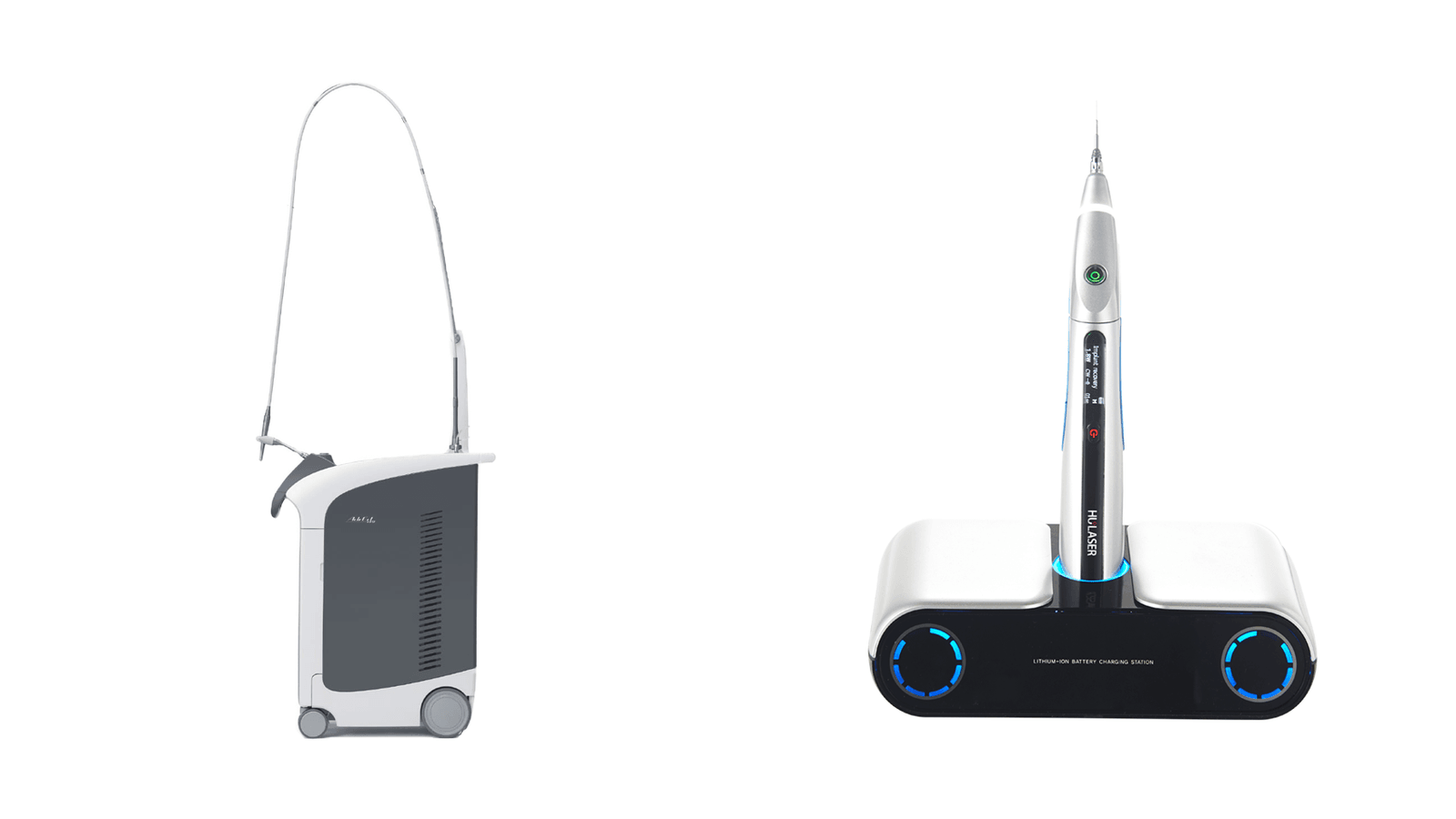
Practices shopping for a first (or second) dental laser often assume “diode” and “Er:YAG” are just two brands of the same tool. They aren’t. The difference comes down to wavelength — and wavelength determines what a laser can physically do once it touches tissue.
A diode laser and an Er:YAG laser are absorbed by completely different targets. That single fact decides whether a laser can only recontour gum tissue or whether it can also prep a cavity or clean an implant surface. Get the wavelength wrong for your case mix and you’ve either overpaid for capability you’ll never use, or bought a laser that can’t do the procedure you needed it for.
What a Diode Laser Is Good At
Diode lasers operate at wavelengths well absorbed by pigmented, vascular soft tissue — hemoglobin and melanin, in plain terms. That makes them well suited to soft-tissue procedures: gingival recontouring, frenectomies, tissue coagulation, and a range of periodontal work where the goal is cutting or managing gum tissue, not bone or enamel.
The HuLaser K2 Mobile is built around that use case. It runs at 980 nm, delivering 3.5 W in continuous wave mode or 6.0 W in pulse mode — enough for the soft-tissue procedures a general or perio-focused practice runs day to day. The handpiece is portable, which matters if you’re moving the unit between operatories rather than dedicating a room to it, and the tips are reusable and autoclavable, so you’re not budgeting for disposables on every case. An OLED display with a built-in gravity sensor keeps the readout oriented and legible no matter how the handpiece is held or rotated mid-procedure — a small detail, but one that matters when you’re glancing at settings without breaking focus on the patient. It carries a 2-year manufacturer’s warranty.
What a diode laser won’t do is hard tissue. It’s not a design flaw — the wavelength simply isn’t absorbed by enamel, dentin, or bone the way it’s absorbed by soft tissue. If your case load is entirely soft-tissue work, that’s not a limitation you’ll ever notice. If you’re picturing a laser that also preps cavities, you’re looking at the wrong category.
For a practice that hasn’t added a laser yet, a diode is usually the accessible entry point: lower cost of entry into laser dentistry, a shorter learning curve, and a tool that earns its keep on procedures most practices already perform regularly.
What Er:YAG Adds
Er:YAG lasers run at 2,940 nm — a wavelength that happens to sit almost exactly on the absorption peak of water. Since both hard and soft dental tissue contain water (enamel and dentin included), an Er:YAG laser can ablate them directly. That’s the real differentiator from diode: it isn’t a more powerful version of the same tool, it’s a different physical interaction with tissue entirely, which opens up procedures a diode simply cannot perform.
The J. Morita AdvErL EVO is built for that hard-and-soft-tissue range. It’s Er:YAG at 2,940 nm, Class 4 classified, and capable of both hard-tissue work — cavity preparation, bone contouring — and the same category of soft-tissue procedures a diode handles. It also carries a 2-year manufacturer’s warranty.
One use case worth calling out specifically: the AdvErL EVO is clinically recognized for peri-implantitis treatment — removing bacteria and biofilm from a compromised implant surface and supporting the tissue regeneration that follows. That’s a procedure a diode laser cannot touch, because it requires interacting with a hard, non-vascular implant surface rather than soft tissue. As implant volume grows in a practice, implant-maintenance capability stops being a nice-to-have and starts being the reason to own an Er:YAG unit at all.
Diode vs. Er:YAG at a Glance
| HuLaser K2 Mobile (Diode) | J. Morita AdvErL EVO (Er:YAG) | |
|---|---|---|
| Wavelength | 980 nm | 2,940 nm |
| Tissue capability | Soft tissue only | Hard tissue and soft tissue |
| Typical use cases | Gingival recontouring, frenectomies, coagulation, general perio work | Cavity preparation, bone work, soft-tissue procedures, peri-implantitis treatment |
| Warranty | 2 years | 2 years |
Which One Your Practice Actually Needs
If your case mix is mostly perio and soft-tissue work and you’re adding your first laser, a diode is the practical starting point. The K2 Mobile covers the procedures you’re already running, at a lower cost of entry, without asking you to pay for hard-tissue capability you won’t use.
If you want one laser that also handles hard-tissue procedures and implant-surface maintenance, that’s an Er:YAG decision, not a diode one — no amount of diode wattage substitutes for a wavelength that hard tissue actually absorbs. The AdvErL EVO is the unit built for that broader scope, with peri-implantitis treatment as a specific, clinically recognized use case.
Plenty of practices eventually run both. A diode handles day-to-day soft-tissue procedures efficiently, while an Er:YAG covers hard-tissue and implant work the diode was never designed for. They solve different clinical problems rather than competing for the same purchase decision, so the question isn’t really “which laser is better” — it’s “which procedures do you need covered, and does that call for one laser or two.”
Browse both units on the dental laser catalog page, or contact Dental TI to talk through your case mix and get a straight answer on which laser — or combination — fits your practice.