
Panoramic X-Ray vs. CBCT: Which Should You Buy First?
· David Hanning
The Question Every New Imaging Build-Out Runs Into
A new practice, or a practice that’s simply never owned in-house imaging, eventually faces the same decision: panoramic X-ray or CBCT first. Most of what’s written online skips past this and jumps straight to comparing CBCT systems, as if 3D is the obvious next step for anyone buying imaging. It isn’t. That comparison assumes you already have 2D and are deciding whether to add 3D on top of it. If you’re starting from nothing, the real question is different, and the honest answer is that it depends on your case mix, not on which technology sounds more advanced.
This isn’t a case for one machine over the other. It’s a framework for figuring out which one your practice actually needs first, and why the two options aren’t mutually exclusive the way they’re often presented.
What Panoramic X-Ray Actually Covers
Panoramic X-ray is the baseline 2D imaging every general practice runs on. A single rotational exposure captures the full upper and lower arches, sinuses, and TMJs in one image, and it does the job for the imaging that shows up in nearly every patient visit: routine screening for decay and bone loss, orthodontic assessment and treatment planning, general diagnosis of pathology, and pre-treatment baseline films before any restorative or surgical work.
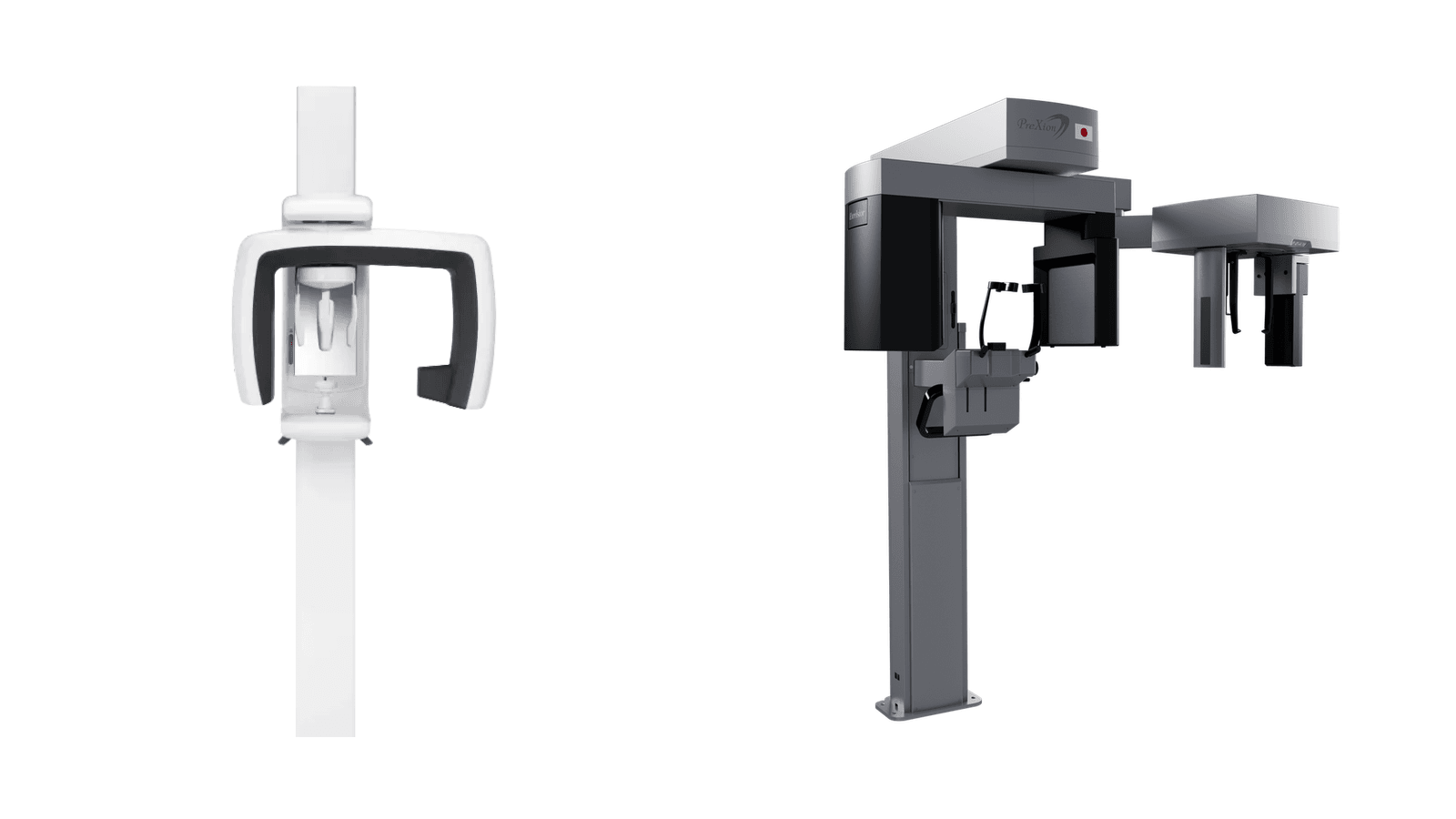
For a general or startup practice, panoramic is also the lower-complexity, lower-capital purchase. The equipment footprint is smaller, staff training is faster, and the workflow slots directly into exams most practices are already running. If your day-to-day case mix is routine hygiene, general restorative work, and the occasional ortho referral, a panoramic unit covers the imaging need without asking you to justify a much larger purchase you may not use consistently. Dental TI’s panoramic X-ray lineup covers this range, from straightforward wall-mounted units to platforms with cephalometric options for practices doing in-house ortho work.
Panoramic X-ray has a real limit, though: it’s a single 2D projection. Overlapping anatomy compresses into one plane, which is exactly where the next imaging question comes from.
What CBCT Adds That Panoramic Can’t
Cone beam CT captures a 3D volume instead of a flat projection, which matters for a specific set of clinical questions that 2D imaging genuinely can’t answer well. Implant placement planning benefits from seeing bone volume, density, and the position of the inferior alveolar nerve or sinus floor in three dimensions before you place a fixture, not after. Endodontic diagnosis of complex canal anatomy, extra canals, resorption, or vertical root fractures, is often invisible on a panoramic film and clear on a CBCT slice. Impacted tooth and wisdom tooth assessment benefits from seeing the actual spatial relationship to the nerve canal and adjacent roots. Airway and TMJ evaluation, and oral surgery or orthognathic planning, all rely on volumetric detail that a 2D image simply doesn’t contain.
If your practice is regularly running into these scenarios, CBCT isn’t an upgrade for its own sake. It’s imaging that matches what you’re actually diagnosing and treating. Dental TI’s CBCT lineup spans field-of-view sizes built around exactly these use cases. For a deeper technical side-by-side of what 3D imaging changes about diagnosis and treatment planning, the CBCT vs. traditional dental X-rays comparison covers that ground in more detail than this post will.
Knowing what each modality covers is the easy part. Deciding which one your practice needs first is where the real work is.
The Decision Framework: Four Questions, Not One Answer
There’s no universal answer here, and any article that gives you one is oversimplifying. What actually determines the right first purchase is your practice’s specific situation, evaluated against four factors.
What does your case mix actually require? Pull your last 100 cases and count how many needed, or would have clearly benefited from, 3D imaging: implant placements, complex endo cases, impaction assessments, airway or TMJ workups. If that number is small, panoramic covers the overwhelming majority of what you’re diagnosing day to day. If it’s a meaningful share, CBCT is answering questions your current workflow can’t.
What’s your referral pattern? Practices that routinely refer implant placement, complex endo, and oral surgery cases out to specialists don’t carry the same 3D imaging need in-house, because that need lives at the specialist’s office, not yours. If referring out is your standard model and you’re not planning to change it, panoramic-only can be the right fit for considerably longer than it would be for a practice building those procedures in-house.
What’s the budget and financing reality? Panoramic units are the lower capital-outlay entry point into in-house imaging, which matters for a startup or a practice managing multiple competing equipment priorities. Committing to CBCT before your case mix or cash flow supports it puts pressure on a purchase that should be justified by clinical need, not urgency. The 2D panoramic X-ray cost guide walks through what to budget on the 2D side, and the complete guide to dental CBCT does the same for 3D.
What’s your growth trajectory? A practice actively building an implant program, expanding endodontic capacity, or adding oral surgery to its service mix should weight CBCT earlier, even if today’s case count doesn’t fully justify it yet, because the equipment needs to be in place before the procedure volume catches up to it.
Run those four questions honestly and most practices land on a clear lean, even if it’s not a unanimous one. But there’s a fifth consideration that changes how much pressure this decision actually carries.
The Upgrade Path: Why “Panoramic First” Doesn’t Mean Starting Over
Here’s the detail most comparisons leave out entirely: buying panoramic first doesn’t have to mean rebuilding your imaging room from scratch if your case mix shifts toward 3D later. Several of the panoramic units Dental TI carries are field-upgradeable to full CBCT on the same installed gantry.
The PreXion Evolve 2D, J. Morita Veraviewepocs 2D, and ACTEON X-Mind Prime 2D all share this design: the panoramic unit you install today sits on the same platform as its CBCT counterpart, so when your case mix, referral pattern, or growth plans change, the upgrade adds 3D capability to hardware you already own and staff already know how to run, rather than requiring a second full installation, a new room layout, and a second round of training from zero.
That matters most for practices genuinely uncertain about their near-term trajectory. If you’re not sure whether you’ll be doing enough implant or endo work in-house within the next two to three years to justify CBCT today, an upgrade-path panoramic unit lets you defer that decision without closing the door on it. You get standard-of-care 2D imaging now, at the lower capital outlay, and a documented route to 3D whenever the case-mix numbers actually support it, instead of guessing today what your practice will need years from now.
This is also worth raising directly with whoever’s helping you plan the purchase. Not every panoramic unit on the market has this upgrade path, and it’s a meaningful factor if there’s any real chance your case mix moves toward 3D-justifying work later.
Get the Actual Numbers Before You Decide
Reading a decision framework is useful, but the number that actually settles this for your practice is the one from your own case mix, not a generic guideline. Pulling your last 100 charts, tallying referral-out rates, and mapping that against your growth plans takes an afternoon and gives you a defensible answer instead of a guess.
If you want help running those numbers, or want a straight comparison of which panoramic and CBCT options fit your specific volume and budget, contact Dental TI and we’ll walk through your case mix with you. That conversation is the fastest way to know which purchase to make first, and whether an upgrade-path unit is worth the consideration for where your practice is headed.