
End the Watch: DC-Air™ and Diagnostic Truth
· David Hanning
Every dentist knows the dreaded “watch.” We spot a suspicious shadow on an interproximal surface, but the margins are fuzzy. Is it an artifact from the software’s sharpening filter, or is it early-stage demineralization? Because we aren’t 100% certain, we tell the patient, “Let’s put a watch on this tooth.”
But let’s be honest: “Watching” a tooth often just means you are not certain about what you are seeing. And fundamentally, you cannot treat what you cannot see.
This uncertainty is rarely your fault; it is an inherent limitation of traditional sensor physics. Most digital sensors on the market rely on Indirect Conversion. They use a scintillator layer to convert X-rays into visible light, which then travels through a fiber-optic glass plate. This process causes the light to scatter or “bloom,” creating a naturally blurry image. To compensate, traditional imaging software applies aggressive sharpening filters to make the image look crisp. While this creates a “pretty” picture, it destroys objective Image Accuracy, hiding the true diagnostic details under digital noise or creating halo artifacts that mimic decay.
The Paradigm Shift: Direct Conversion and Diagnostic Truth
The DC-Air™ wireless sensor eliminates the “watch” by eliminating the uncertainty. It utilizes Direct Conversion technology, capturing X-ray photons directly into an electronic signal on a single-crystal silicon semiconductor, bypassing the light-conversion step entirely.
Because there is no light scatter, there is no blur. The DC-Air™ delivers a clear, “native” image that preserves the subtle gradations of the tooth structure without relying on pixel-altering software filters. You are seeing the actual anatomy, verified by an industry-leading Modulation Transfer Function (MTF) of >70% at 5 lp/mm.
When you can zoom in on an image without it breaking down into pixelated noise, incipient decay jumps out at you. You no longer have to guess if a shadow is real. As clinicians have noted, the DC-Air™ allows you to capture and find things that would have been completely missed with a regular digital sensor.
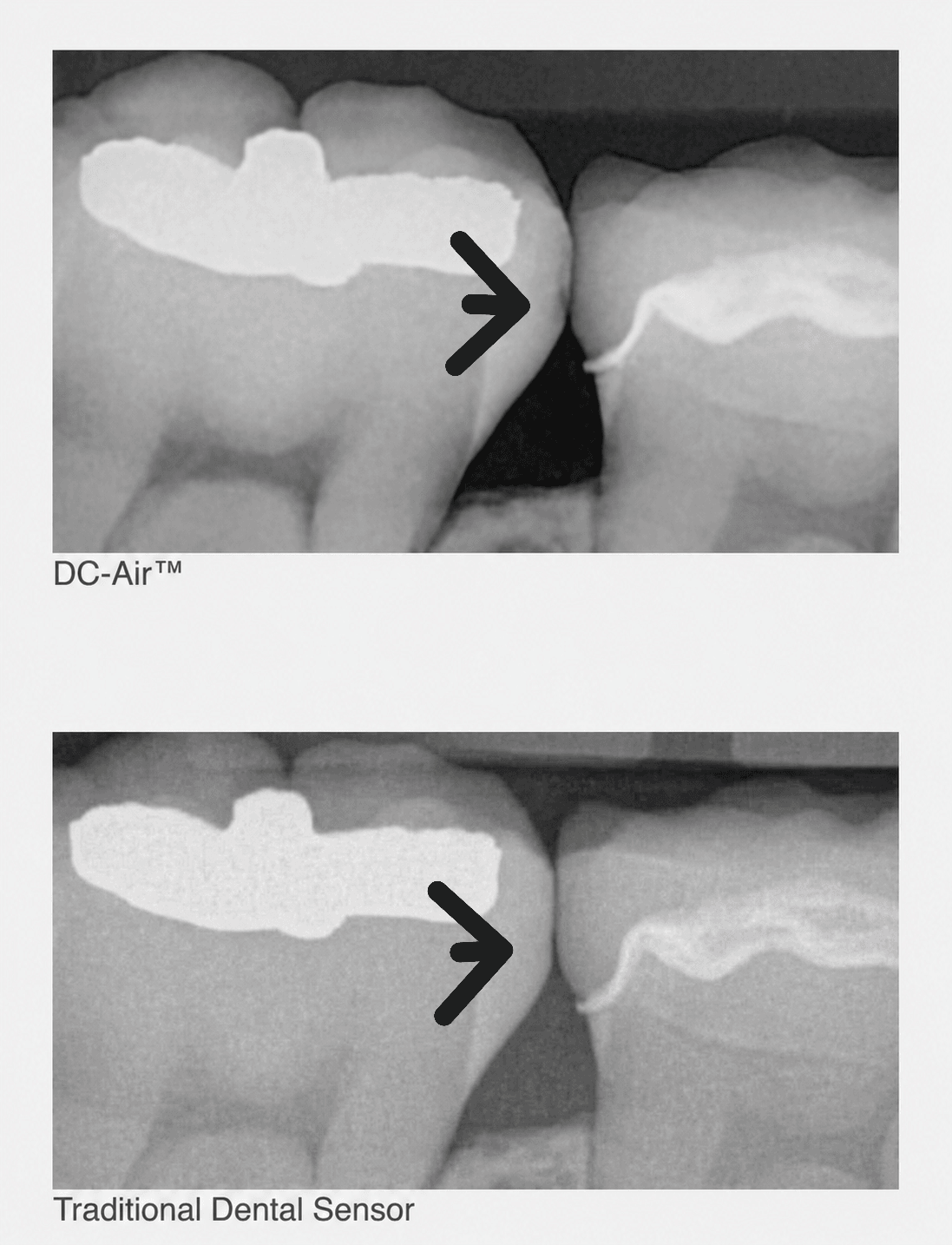
You Cannot Treat What You Cannot See
The ROI of Clinical Certainty
The return on investment (ROI) of the DC-Air™ starts right in the operatory. When you have total confidence in your diagnosis, your case acceptance rate goes up. Instead of telling a patient, “We’ll watch it for six months,” you can clearly show them the high-definition, unfiltered reality of their decay and recommend immediate treatment. By diagnosing it right the first time, you provide a better service to your patient and significantly increase your practice’s production. Expect at least a 10-20% increase in the diagnoses of incipient caries with certainty based on the DC-Air™‘s™ class leading Image Accuracy IA.
The ROI of Durability: Cutting the Cord
The financial ROI extends far beyond case acceptance. With traditional wired sensors, the cable is the number one point of failure, responsible for roughly 90% of sensor breakdowns. When a patient bites a wire or it wears out from constant USB plugging and unplugging, you are looking at cable repair costs ranging from $1200 to over $1,800 per incident, not to mention the cost of operatory downtime.
The DC-Air™ is a true wireless sensor utilizing Bluetooth® Low Energy (BLE). By cutting the cord, you eliminate the industry’s biggest failure point and recurring expense. Furthermore, because Direct Conversion technology removes the fragile glass fiber-optic plates and scintillators, the DC-Air™ features a homogenous silicon construction. It is incredibly robust, highly resistant to drops and bite force, and completely water and dust resistant (IP67).
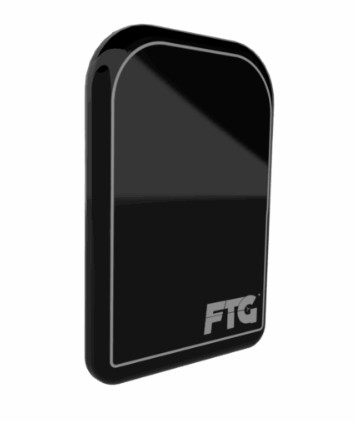 *The DC-Air™ - The World's ONLY True Wireless Dental Sensor*
Stop Diagnosing a Filter
You wouldn’t treat a patient blindfolded, so why diagnose through a cosmetic software filter? By upgrading to the DC-Air™, you gain the “diagnostic truth” needed to treat with certainty, combined with the extreme durability of a wireless, glass-free design.
The ultimate ROI of the DC-Air™ is knowing exactly what you are looking at—and never having to just “watch” a blurry shadow again.
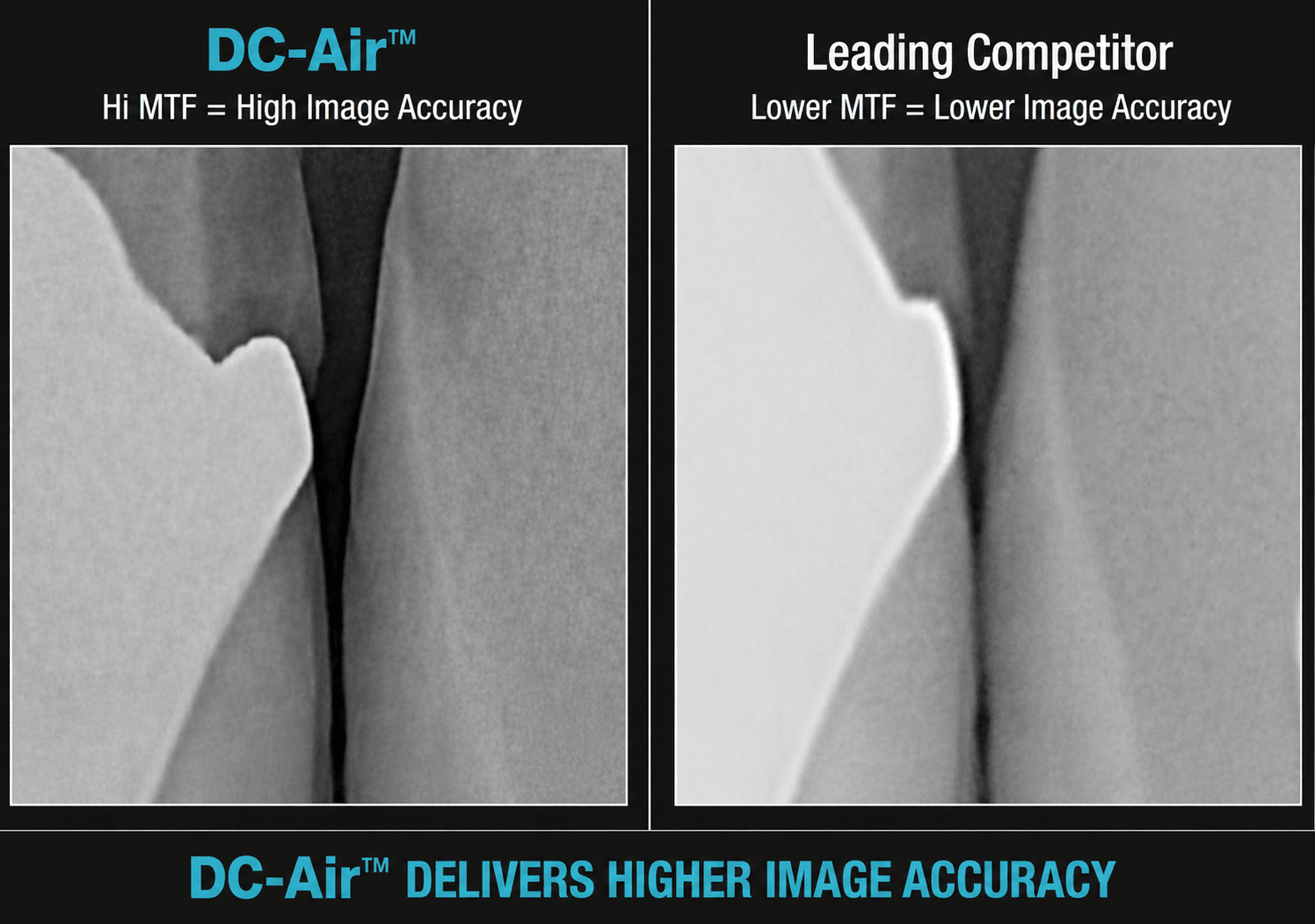 *The DC-Air™ Delivers Image Accuracy*
Future-Proof Your Practice — Invest in Confidence
The dental industry is evolving faster than ever, and the practices that will thrive are the ones that invest in technology that builds trust at every appointment. The DC-Air™ isn’t just an upgrade — it’s a transformation. It transforms uncertain shadows into definitive diagnoses. It transforms hesitant patients into confident ones who say yes. It transforms a reactive practice into a proactive powerhouse built on clinical certainty.
When your imaging technology tells the truth, everything changes. Your confidence grows. Your patients’ trust deepens. Your production climbs. And that blurry, ambiguous shadow on an interproximal surface? It becomes a clear, actionable diagnosis — same day, every time. Eliminate the uncertainty, and you eliminate the delay. Eliminate the delay, and your practice grows.
The DC-Air™ is more than a wireless sensor. It’s a statement to your patients that you are equipped with the best diagnostic technology available — and that their oral health deserves nothing less. It’s durable enough to outlast the competition, precise enough to catch what others miss, and intelligent enough to pay for itself in the very first month.
Protect and Monitor Your Investment
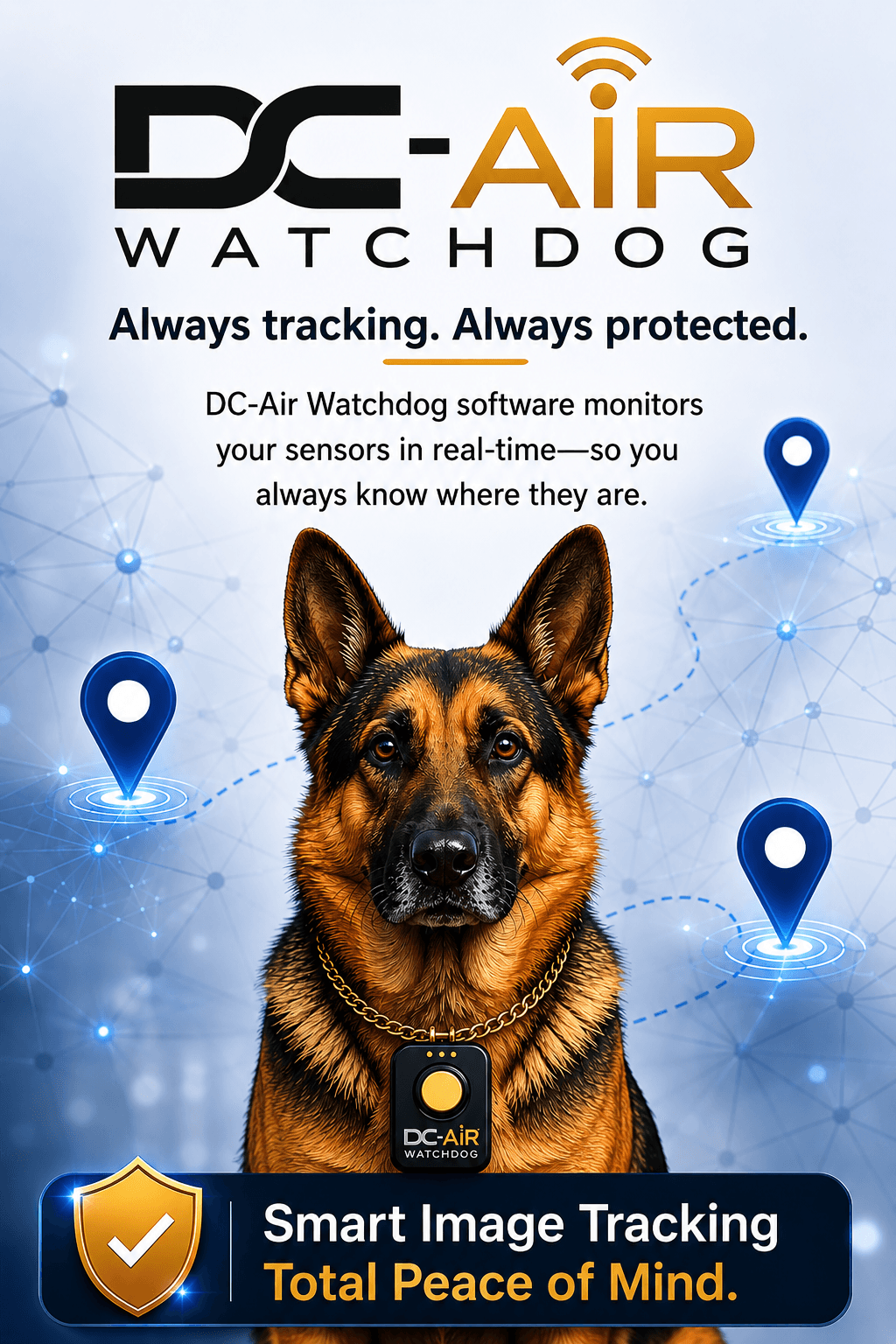 *Watchdog Keeps Track or Your DC-Air™'s Location and More*
DC-Air™ WatchDog is the intelligence layer behind the DC-Air™ ecosystem — continuously monitoring your sensors, operatories, and imaging workflow in real time. While the DC-Air™ sensor delivers exceptional image quality and wireless freedom, WatchDog protects your investment by ensuring you always know where your sensors are and how your imaging operation is performing.
If a DC-Air™ sensor goes missing or out of range, WatchDog instantly alerts your team with live notifications, dock awareness, and last-known-location tracking — helping prevent costly loss and workflow disruption before it happens.
Beyond protection, WatchDog delivers real-time productivity metrics, image quality APIs, operatory efficiency tracking, and centralized analytics that help practices optimize imaging performance across the entire organization. The result is a smarter, more accountable imaging ecosystem that helps your practice get the absolute most from every DC-Air™ sensor.
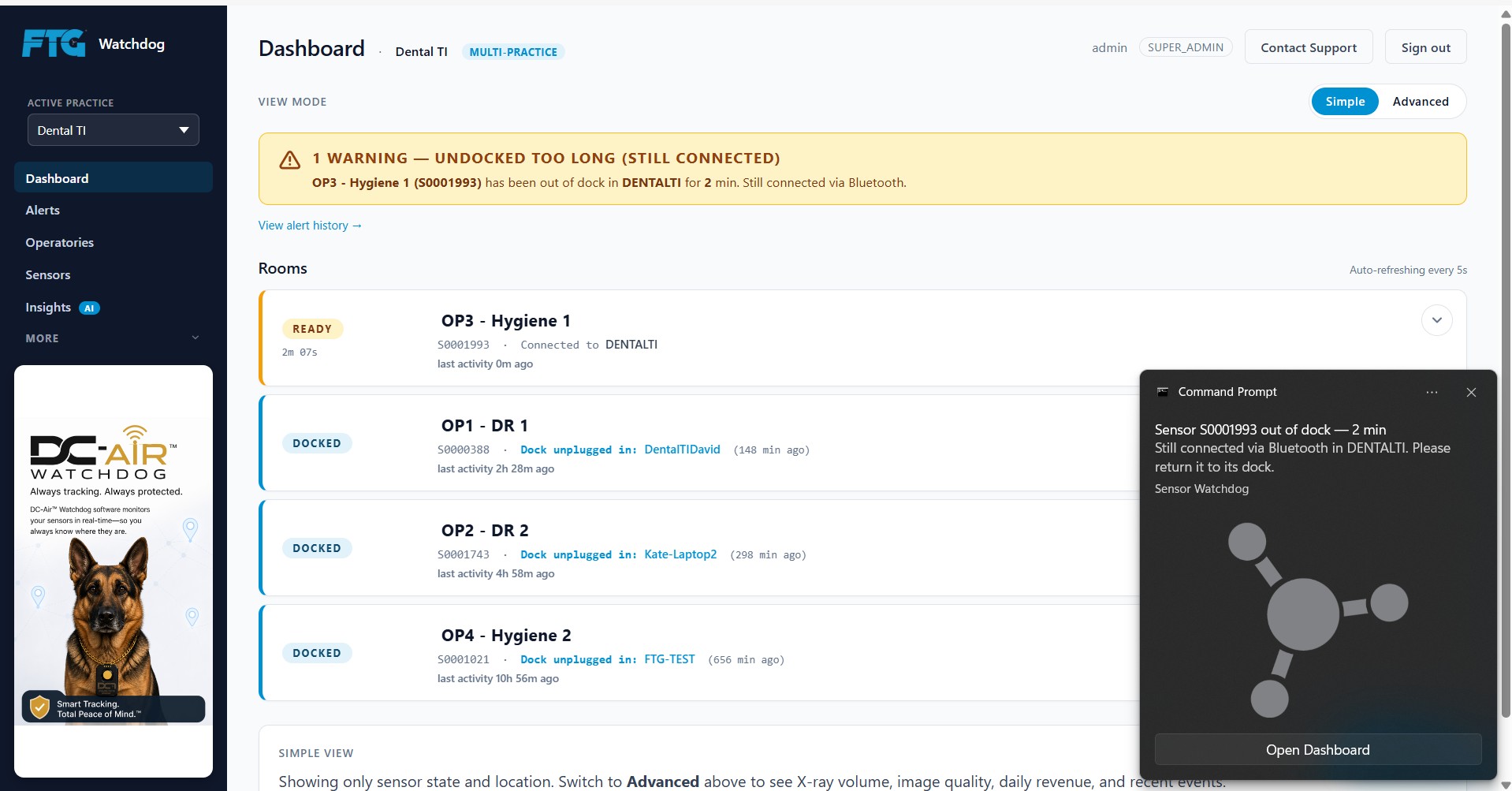
WatchDog uses a Secure Portal to Monitor DC-Air™ Sensors and Provide Notifications
Ready to Trade Up? Dental TI Is Making It Easier Than Ever.
Dental TI is making it easier than ever to trade in your outdated sensor and move up to true wireless with AI-grade image accuracy. For a limited time, receive up to a $2000 trade-in for your sensor. Whether you’re running a solo practice or a multi-location group, the DC-Air™ fits your workflow, your operatory, and your vision for the future.
Contact us today to learn more about how the DC-Air™ is a practice builder and a patient favorite. Your next level of diagnostic certainty is one conversation away. Let’s make the upgrade together — because your patients deserve diagnostic truth, and your practice deserves to grow.
Prefer to see it before you call? Watch the DC-Air™ video library for demonstrations and real practice testimonials.
Get a DC-Air quote for your practice
Tell us about your rooms and imaging software. We'll confirm compatibility, compare the two kit options and include any eligible sensor trade-in in your quote.
Requesting a quote does not enroll you in a plan or commit you to a purchase.